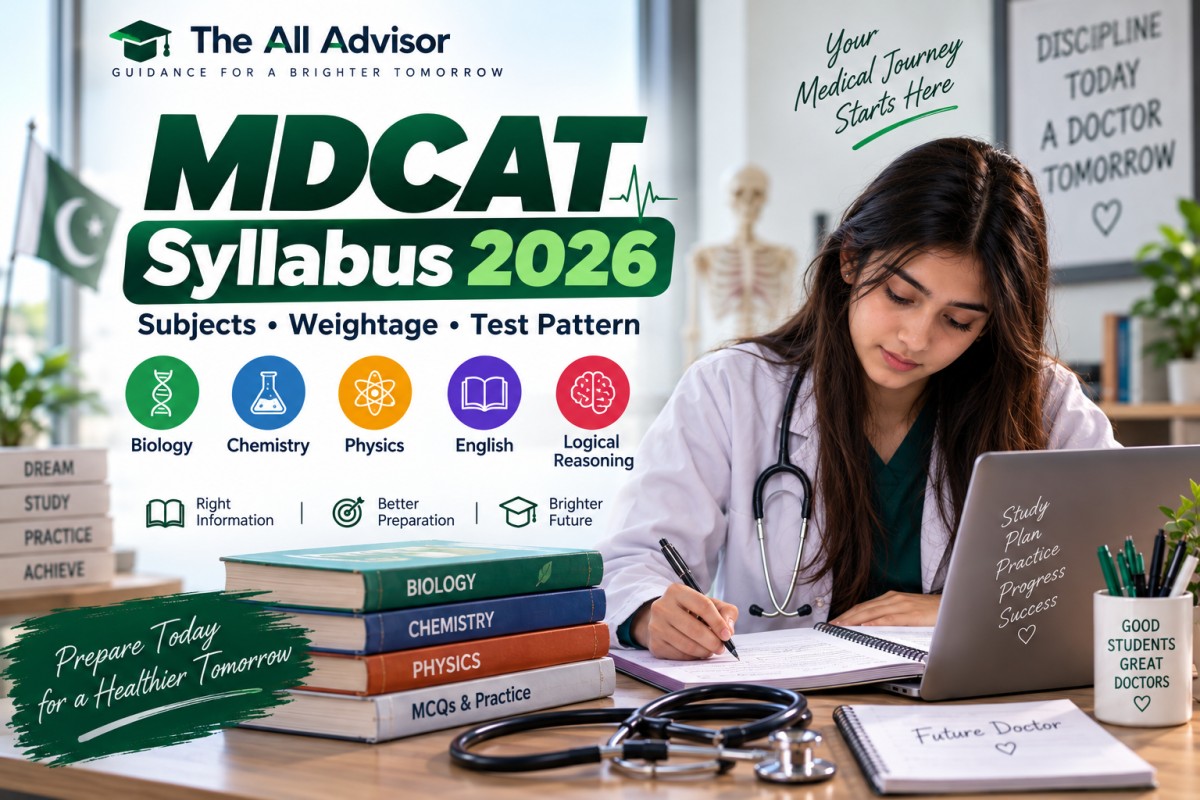
MDCAT Syllabus 2026: Subjects, Weightage & Test Pattern
Preparing for MDCAT becomes much easier when students know exactly what they are expected to study.
Instead of collecting dozens of books, notes, videos, and MCQ banks without a clear direction, candidates should begin with the MDCAT syllabus 2026 and use it as the foundation of their preparation.
The syllabus helps students understand which subjects are included, how much weight each subject carries, what learning outcomes need attention, and how the examination is structured.
For MDCAT 2026, the test consists of 180 multiple-choice questions covering Biology, Chemistry, Physics, English, and Logical Reasoning. Biology carries the largest share of the examination, followed by Chemistry and Physics, while English and Logical Reasoning make up the remaining portion.
This guide explains the MDCAT syllabus, subject distribution, test pattern, difficulty levels, and a practical way to organize your preparation around the official curriculum.
Important: Students should always use the latest curriculum and examination instructions published by the Pakistan Medical and Dental Council (PM&DC). Test policies and administrative instructions may be updated, so official information should take priority over academy notes or older online material.
If you are new to the admission process, start with our MDCAT 2026 complete guide to understand eligibility, registration, test structure, preparation, and MBBS/BDS admission in Pakistan.
MDCAT Syllabus 2026 Overview
The MDCAT syllabus is designed to assess more than a student’s ability to memorize textbook information.
The science sections test knowledge and understanding across Biology, Chemistry, and Physics, while English evaluates relevant language skills and Logical Reasoning assesses the candidate’s ability to analyze information and reach logical conclusions.
The MDCAT 2026 subject distribution is:
| Subject | Number of MCQs | Weightage |
|---|---|---|
| Biology | 81 | 45% |
| Chemistry | 45 | 25% |
| Physics | 36 | 20% |
| English | 9 | 5% |
| Logical Reasoning | 9 | 5% |
| Total | 180 | 100% |
This distribution immediately shows why students need a balanced preparation strategy.
Biology alone accounts for almost half of the examination, but the other four sections collectively account for the remaining 55%.
A candidate who prepares Biology exceptionally well but neglects Chemistry, Physics, English, or Logical Reasoning can therefore lose a substantial number of marks.
Which Syllabus Applies to MDCAT 2026?
Students may notice that the official curriculum document currently carries the MDCAT 2025 title.
This can understandably create confusion for candidates preparing for the 2026 examination.
PM&DC’s currently published final MDCAT curriculum provides the subject content, learning objectives, examination structure, weightage, and difficulty framework relevant to the test pattern being used for MDCAT 2026.
Students should therefore work from the curriculum officially provided through PM&DC rather than downloading an unofficial PDF simply because its filename contains “2026.”
Before beginning preparation, students should review the official MDCAT syllabus and use its learning objectives as a checklist for their studies.
MDCAT 2026 Test Pattern
Understanding the syllabus is only one part of preparation. Students should also understand how that syllabus is converted into an examination.
The announced MDCAT 2026 pattern includes:
- 180 total MCQs
- Paper-based examination
- Questions in English
- No negative marking
- Five tested areas
- Biology carrying the highest weightage
The official curriculum framework also divides questions by difficulty:
| Difficulty Level | Approximate Share |
|---|---|
| Easy | 15% |
| Moderate | 70% |
| Difficult | 15% |
The majority of the examination is therefore expected to consist of questions categorized at the moderate level.
This is one reason students should avoid preparing only through memorization.
A candidate needs enough conceptual understanding to recognize a familiar concept even when the question is presented differently from the example seen in a textbook or MCQ book.
Biology Syllabus for MDCAT 2026
Biology is the largest component of MDCAT.
It contains 81 MCQs, representing 45% of the complete examination.
For a student targeting a competitive score, Biology deserves significant preparation time. However, the goal should not simply be to memorize large amounts of information.
Students should understand biological processes, relationships, terminology, structures, and functions according to the learning outcomes specified in the curriculum.
The official Biology curriculum covers major areas such as:
Acellular Life
Students should understand concepts associated with viruses and related biological principles included in the curriculum.
The focus should be on understanding characteristics and relevant biological processes rather than simply memorizing isolated definitions.
Bioenergetics
Bioenergetics deals with how living systems obtain, transform, and use energy.
Students should be comfortable with the biological processes and relationships identified under the relevant learning outcomes.
Biological Molecules
This area builds understanding of the molecules essential to living organisms.
Students should understand their characteristics, biological importance, and relationships rather than treating them as disconnected facts.
Cell Structure and Function
Cells form the basic structural and functional units of life.
Candidates should understand cellular structures and how their functions contribute to biological processes.
Diagrams can be particularly useful when revising cell-related concepts.
Coordination and Control
This area focuses on mechanisms that allow organisms to respond to internal and external changes.
Students should understand the relevant systems, structures, and processes described in the official curriculum.
Diversity
Biological diversity introduces students to variation among living organisms and the principles used to understand different forms of life.
Enzymes
Students should understand how enzymes function, the factors affecting their activity, and their role in biological reactions.
Conceptual clarity is especially useful here because questions may test the application of a principle rather than a memorized sentence.
Evolution
Candidates should understand the fundamental concepts and mechanisms related to biological evolution included in the curriculum.
Life Processes in Animals and Plants
This broad area involves important physiological processes in living organisms.
Students should connect structures with functions and understand how different biological systems operate.
Prokaryotes
Students should understand relevant characteristics and biological concepts associated with prokaryotic organisms.
Reproduction
The curriculum includes important concepts associated with reproduction and related biological mechanisms.
Support and Movement
Students should understand structures and processes involved in support and movement and how they function within living systems.
Variation and Genetics
Genetics is an important conceptual area.
Instead of memorizing terminology alone, students should understand inheritance, variation, and the relationships between the genetic concepts included in the curriculum.
How to Prepare Biology for MDCAT
Because Biology contains 81 questions, students should give it substantial attention without allowing it to consume their entire preparation schedule.
A useful Biology preparation cycle is:
Learn → Understand → Recall → Practice → Review
Start by studying a topic against the relevant syllabus learning outcomes.
After understanding the topic, close the book and try to recall the important concepts without looking at your notes.
Then attempt MCQs.
When you make a mistake, identify whether it happened because of:
- weak conceptual understanding,
- forgotten information,
- confusion between similar terms,
- incorrect interpretation of the question, or
- careless reading.
Keep a separate record of repeated mistakes.
That mistake record can become one of your most valuable revision resources close to the examination.
Chemistry Syllabus for MDCAT 2026
Chemistry contributes 45 MCQs, representing 25% of MDCAT.
The subject requires a combination of conceptual understanding, factual knowledge, chemical relationships, and problem-solving ability.
Students should avoid treating all Chemistry topics in exactly the same way.
Some areas require strong conceptual understanding, while others may involve equations, reactions, calculations, structures, or trends.
Major areas of the official Chemistry curriculum include topics covering:
Fundamental Concepts of Chemistry
Students should be comfortable with the foundational principles that support later Chemistry topics.
Weak fundamentals can make more advanced concepts unnecessarily difficult.
Atomic Structure
Understanding atomic structure provides a foundation for explaining chemical behavior and relationships.
Gases
Candidates should understand the principles and relationships governing gaseous systems according to the prescribed learning outcomes.
Liquids
This area involves properties and behavior associated with the liquid state.
Solids
Students should understand the relevant concepts related to solid matter and its characteristics.
Chemical Equilibrium
Equilibrium is an important conceptual topic.
Rather than memorizing individual statements, students should understand how equilibrium systems behave and how changes can affect them.
Reaction Kinetics
Candidates should understand the factors and principles associated with rates of chemical reactions.
Thermochemistry and Energetics
This area connects chemical reactions with energy changes.
Students should be comfortable interpreting relevant concepts and relationships.
Electrochemistry
Electrochemical concepts require careful understanding of chemical processes involving electrical phenomena.
Chemical Bonding
Bonding is fundamental to understanding molecular structures and chemical behavior.
Students should understand why bonds form and how bonding relates to molecular properties.
S- and P-Block Elements
Students should study relevant properties, trends, and chemical behavior according to the prescribed curriculum.
Transition Elements
Candidates should understand the relevant characteristics and chemical behavior of transition elements included in the syllabus.
Organic Chemistry
Organic Chemistry includes several interconnected areas.
Rather than learning each reaction in isolation, students should identify patterns between structures, functional groups, properties, and reactions.
Hydrocarbons
Students should understand the structure, properties, and reactions of relevant hydrocarbons.
Alkyl Halides
Study the relevant properties and chemical behavior included in the learning objectives.
Alcohols and Phenols
Candidates should understand important characteristics, reactions, and distinctions.
Aldehydes and Ketones
Students should learn how structure influences properties and chemical reactions.
Carboxylic Acids
Focus on the concepts and reactions prescribed by the curriculum.
Macromolecules
This area connects Chemistry with larger molecular structures and their significance.
How to Prepare Chemistry for MDCAT
Divide Chemistry preparation into three types of work:
Conceptual topics: Understand the principle before attempting MCQs.
Calculation-based topics: Practise solving problems without relying excessively on worked examples.
Reaction/fact-based topics: Use active recall and repeated revision.
A common mistake is reading solved Chemistry MCQs and believing that this counts as practice.
It does not.
Try answering the question first. Only then check the explanation.
Physics Syllabus for MDCAT 2026
Physics accounts for 36 MCQs, or 20% of the examination.
Students sometimes find Physics difficult because knowing a formula does not necessarily mean knowing when or how to apply it.
MDCAT Physics preparation should therefore combine:
- conceptual understanding,
- formula familiarity,
- units,
- relationships between quantities,
- numerical problem solving, and
- MCQ practice.
The curriculum covers important Physics areas including:
Force and Motion
Students should understand motion and the principles governing forces and their effects.
Work and Energy
Candidates should understand relationships involving work, energy, and related physical quantities.
Rotational and Circular Motion
These topics require understanding of motion beyond simple linear systems.
Waves
Students should understand fundamental wave properties and relevant relationships.
Thermodynamics
This area focuses on thermal processes, energy transfer, and associated physical principles.
Electrostatics
Students should understand electric charge, fields, forces, and related concepts prescribed by the curriculum.
Current Electricity
Candidates should understand electrical quantities, relationships, and circuit-related concepts.
Electromagnetism
This section connects electricity and magnetism and requires clear conceptual understanding.
Electromagnetic Induction
Students should understand the relevant principles governing induced electrical effects.
Alternating Current
Candidates should study the properties and behavior associated with alternating electrical systems as prescribed.
Electronics
This area introduces relevant electronic principles and components.
Dawn of Modern Physics
Students should understand the fundamental ideas that led to modern developments in Physics.
Atomic Spectra
Candidates should understand concepts associated with atomic energy states and spectra.
Nuclear Physics
This section covers relevant principles associated with the atomic nucleus and nuclear phenomena.
How to Prepare Physics for MDCAT
Physics becomes easier when students stop treating formulas as isolated lines to memorize.
For each formula, ask:
What does each variable represent?
Which units are used?
What happens when one quantity increases or decreases?
Under what conditions does this relationship apply?
Can I solve a simple numerical problem using it?
Create a compact formula sheet, but do not use it as a substitute for understanding.
After completing each topic, practise both conceptual and numerical MCQs.
If calculations repeatedly consume too much time, practise the underlying mathematical steps separately.
English Syllabus for MDCAT 2026
English contributes 9 MCQs, representing 5% of the examination.
Because the section is smaller than the three science subjects, some students postpone English preparation until the final days.
That can be a mistake.
Nine questions may appear small in isolation, but every mark can matter when students are competing for medical and dental admission.
The English section is designed around language skills and the learning outcomes prescribed in the official curriculum.
Students may need to demonstrate abilities involving areas such as:
- comprehension of written English,
- vocabulary in context,
- appropriate word usage,
- grammar,
- sentence structure,
- identifying errors, and
- understanding relationships within sentences or passages.
Preparation should focus on actual language use rather than memorizing random vocabulary lists without context.
How to Prepare English for MDCAT
Spend a small but regular amount of time on English.
For example, a candidate might dedicate 15–25 minutes during a study session to English instead of leaving the entire section until the end of preparation.
When learning vocabulary, study words in sentences.
When practising grammar, understand why an option is correct rather than memorizing the answer.
Regular short sessions can be more effective than occasional long sessions.
Logical Reasoning Syllabus for MDCAT 2026
Logical Reasoning contributes another 9 MCQs, representing 5% of MDCAT.
This section differs from Biology, Chemistry, and Physics because it primarily tests the student’s ability to analyze information and reason through a problem.
Students may encounter reasoning tasks involving areas such as:
Critical Thinking
Candidates may need to evaluate information and determine which conclusion is logically supported.
Letter and Symbol Series
Students may need to identify patterns or relationships within sequences.
Logical Deduction
A set of statements or conditions may need to be analyzed to determine a valid conclusion.
Logical Problems
Candidates may need to interpret given information and solve a structured reasoning problem.
Course of Action
Some reasoning situations require candidates to determine an appropriate or logical response based on the information provided.
Cause and Effect
Students should be able to distinguish between events and identify logical causal relationships where applicable.
How to Prepare Logical Reasoning
Logical Reasoning improves primarily through practice.
Reading theory alone is unlikely to be enough.
When solving a reasoning question:
- Read the information carefully.
- Identify exactly what is being asked.
- Separate facts from assumptions.
- Look for the underlying relationship or pattern.
- Eliminate options that contradict the information.
- Select the conclusion best supported by the question.
If you answer incorrectly, review the reasoning process rather than simply memorizing the correct option.
MDCAT Subject Weightage: Where Should You Spend the Most Time?
Looking only at the official weightage, a hypothetical 100-hour study allocation would appear roughly like this:
| Subject | Weightage | Proportional Hours |
|---|---|---|
| Biology | 45% | 45 hours |
| Chemistry | 25% | 25 hours |
| Physics | 20% | 20 hours |
| English | 5% | 5 hours |
| Logical Reasoning | 5% | 5 hours |
However, students should not blindly follow this ratio.
Your personal study plan should consider both:
Exam weightage + your current ability
Suppose Biology is already your strongest subject but Physics is consistently producing weak scores. In that situation, giving additional time to Physics may improve your total score more than spending every study hour strictly according to the official percentages.
Weightage should guide your schedule, not control it completely.
How to Use the MDCAT Syllabus as a Study Checklist
One of the simplest ways to make the official syllabus useful is to turn it into a progress tracker.
Create four columns:
| Topic | Concept Complete | MCQs Practised | Revision |
|---|---|---|---|
| Topic 1 | ✓ | ✓ | ✓ |
| Topic 2 | ✓ | ✓ | Pending |
| Topic 3 | ✓ | Pending | Pending |
| Topic 4 | Pending | Pending | Pending |
This provides a much clearer picture of preparation than saying:
“I have almost finished Biology.”
Finishing a chapter once is not necessarily the same as being ready to answer questions from it.
A topic should ideally move through three stages:
Understand → Practice → Revise
Only then should you consider it reasonably prepared.
Should You Study Topics Outside the MDCAT Syllabus?
The official syllabus should define the core boundary of your MDCAT preparation.
Reference books, teachers, video lectures, and academy notes can help explain a listed topic, but additional resources should support the syllabus rather than continuously expand it.
Before spending hours studying something extra, ask:
“Which official learning outcome am I trying to understand?”
If you cannot connect the material to a prescribed learning outcome, check whether it is actually necessary for MDCAT preparation.
This simple habit can save a considerable amount of time.
Textbooks vs MDCAT Preparation Books
Students often ask whether textbooks or dedicated MDCAT books are better.
They serve different purposes.
Textbooks
Useful for:
- understanding concepts,
- building foundational knowledge,
- reviewing explanations, and
- clarifying difficult topics.
MDCAT Preparation Books
Useful for:
- MCQ practice,
- testing recall,
- identifying weak areas, and
- becoming comfortable with question-based preparation.
Neither should automatically replace the other.
A student who only reads textbooks may lack sufficient MCQ practice.
A student who only solves MCQs may repeatedly make mistakes because the underlying concepts were never properly understood.
A stronger approach is:
Concept → MCQs → Error Review → Revision
How to Divide the MDCAT Syllabus for Daily Preparation
Avoid trying to complete an entire subject before touching another.
A balanced day might include:
Session 1 – Biology
Study or revise a high-priority Biology topic.
Session 2 – Chemistry or Physics
Alternate according to your weaknesses and study schedule.
Session 3 – MCQ Practice
Attempt questions from topics already studied.
Session 4 – English or Logical Reasoning
Keep these sections active through shorter regular sessions.
Final Review
Spend a few minutes reviewing mistakes made during the day.
The exact schedule should be adapted to the student’s available time.
A full-time MDCAT candidate and a student simultaneously attending college should not necessarily follow the same timetable.
Common Mistakes When Preparing the MDCAT Syllabus
Trying to Finish Everything Too Quickly
Completing a chapter is useful only if you can recall and apply what you studied.
Prioritize retention over speed.
Studying Without Tracking Progress
A syllabus checklist can reveal topics that have been repeatedly postponed.
Ignoring Small Subjects
English and Logical Reasoning together contribute 18 questions.
They should not be ignored.
Spending Too Much Time Making Notes
Beautiful notes are not the objective.
Understanding, recall, application, and accuracy matter more.
Solving MCQs Without Reviewing Mistakes
Practice becomes much less useful if incorrect answers are never analyzed.
Using Outdated Syllabus Material
Always compare your study material with the currently applicable official curriculum.
Giving Every Topic Equal Time
Some topics will require more work because of your personal weaknesses.
Adjust accordingly.
How to Know Whether You Have Completed the MDCAT Syllabus
Do not judge completion only by whether you have read every chapter.
A better test is whether you can:
- explain the main concept without looking at the book,
- recognize important relationships,
- solve relevant MCQs,
- identify why an incorrect option is wrong,
- recall important information after several days, and
- perform reasonably well under time pressure.
If you studied a topic yesterday but cannot answer basic questions about it today, that topic probably needs revision.
MDCAT Syllabus Revision Strategy
Revision should begin before the entire syllabus is finished.
Waiting until the last chapter is complete can cause earlier topics to fade from memory.
Use a rolling revision system.
For example:
Daily: Review recent mistakes and difficult concepts.
Every few days: Revisit previously completed topics.
Weekly: Test yourself across multiple subjects.
Final preparation stage: Shift increasingly toward mixed MCQs, timed practice, error correction, and rapid concept revision.
This creates repeated contact with important information and reduces the amount that needs to be relearned near the examination.
MDCAT Syllabus vs Test Pattern: What Is the Difference?
These terms are often used interchangeably, but they refer to different things.
MDCAT Syllabus
The syllabus tells you what you need to study.
It contains the subjects, topics, and learning outcomes relevant to the examination.
MDCAT Test Pattern
The test pattern tells you how you will be tested.
It describes factors such as:
- total number of questions,
- subject distribution,
- examination format,
- language,
- negative-marking policy, and
- difficulty distribution.
Students need to understand both.
Knowing the syllabus without understanding the test format can lead to inefficient practice, while knowing the test pattern without covering the syllabus leaves major knowledge gaps.
Frequently Asked Questions About MDCAT Syllabus 2026
What is the MDCAT syllabus for 2026?
The MDCAT curriculum covers Biology, Chemistry, Physics, English, and Logical Reasoning. Candidates should use the curriculum officially published through PM&DC and check for any subsequent updates before the examination.
How many questions are in MDCAT 2026?
MDCAT 2026 consists of 180 multiple-choice questions (MCQs) under the announced test pattern.
Which subject has the highest weightage in MDCAT?
Biology has the highest weightage at 45%, corresponding to 81 MCQs.
How many Chemistry MCQs are in MDCAT?
Chemistry contains 45 MCQs, representing 25% of the examination.
How many Physics MCQs are in MDCAT?
Physics contains 36 MCQs, representing 20% of the examination.
How many English questions are in MDCAT?
English contributes 9 MCQs, or 5% of the examination.
How many Logical Reasoning questions are in MDCAT?
Logical Reasoning contributes 9 MCQs, representing 5% of the examination.
Is there negative marking in MDCAT 2026?
According to the announced MDCAT 2026 test pattern, there is no negative marking.
Is MDCAT 2026 paper-based or computer-based?
The announced MDCAT 2026 format is a paper-based multiple-choice examination.
Is MDCAT conducted in English?
Yes. The announced MDCAT 2026 examination pattern specifies English as the language of the test.
What is the difficulty level of MDCAT?
The official curriculum framework allocates approximately 15% easy, 70% moderate, and 15% difficult questions.
Should I prepare every MDCAT subject?
Yes. All five sections contribute to the final score. Focusing exclusively on Biology would leave 99 of the 180 questions from Chemistry, Physics, English, and Logical Reasoning.
Can I prepare only from MDCAT MCQ books?
MCQ books are useful for practice, but they should not replace conceptual learning. Use reliable academic material to understand a topic first and then use MCQs to test your understanding and identify weak areas.
Should I study topics outside the official syllabus?
Your primary preparation should remain aligned with the official MDCAT syllabus. Additional resources can be used to understand listed concepts, but unnecessary out-of-syllabus study can consume valuable preparation time.
How should I start preparing the MDCAT syllabus?
Start by reviewing the official curriculum, convert its learning outcomes into a checklist, identify your strong and weak topics, and then follow a cycle of concept study, MCQ practice, mistake analysis, and revision.
Final Thoughts
The MDCAT syllabus 2026 should be the starting point of your preparation rather than something you check after collecting study material.
The examination contains 180 MCQs, with Biology carrying 45%, Chemistry 25%, Physics 20%, English 5%, and Logical Reasoning 5%.
These percentages are useful for planning, but effective preparation should also reflect your individual strengths and weaknesses.
Instead of measuring progress by the number of books completed or hours spent studying, measure it by what you can understand, recall, apply, and answer correctly.
Use the official syllabus to define what you need to learn. Use textbooks and reliable resources to understand it. Use MCQs to test it. Use mistakes to identify weaknesses. And use regular revision to retain what you have learned.
A structured approach to the syllabus will not make MDCAT effortless, but it can make your preparation much more focused, measurable, and efficient.
Students who need a broader understanding of the entire admission journey can explore our complete MDCAT 2026 guide for students in Pakistan, which explains eligibility, registration, test structure, preparation, aggregate basics, and the role of MDCAT in MBBS and BDS admissions.