MDCAT 2026: Complete Guide for Students in Pakistan
For thousands of students in Pakistan, completing FSc Pre-Medical or an equivalent qualification is only one part of the journey toward medical or dental education. Students planning to compete for admission to MBBS or BDS programs also need to understand the Medical and Dental College Admission Test, commonly known as MDCAT.
The MDCAT 2026 is particularly important for students who want to pursue undergraduate medical or dental education in Pakistan. However, preparing for the test is not only about studying Biology, Chemistry, and Physics. Students should also understand the eligibility requirements, test structure, registration process, admission rules, and the role their MDCAT score plays in medical college merit.
This guide brings the most important MDCAT information together in one place so that students and parents can understand the process without having to piece together information from multiple sources.
Important: MDCAT rules, schedules, admission policies, and other requirements can be updated by the relevant authorities. Students should always verify time-sensitive information through PM&DC before making an admission-related decision.
What Is MDCAT?
MDCAT stands for Medical and Dental College Admission Test.
It is an admission test associated with entry into undergraduate medical and dental education in Pakistan. For students pursuing MBBS or BDS through the standard domestic admission route, passing MDCAT forms part of the mandatory eligibility criteria prescribed under the applicable PM&DC admission regulations.
MDCAT should therefore not be viewed as an isolated examination. It works alongside a student’s previous academic qualifications and the admission or merit framework applicable to the medical or dental college they are applying to.
In simple terms:
HSSC/FSc or equivalent qualification establishes your academic background, while MDCAT is an additional admission requirement used in the medical and dental admission process.
Students should also understand an important distinction: passing MDCAT does not automatically guarantee admission to an MBBS or BDS program.
Admission remains competitive and depends on the applicable merit calculation, available seats, eligibility requirements, and the admission process followed by the relevant authority or institution.
Who Conducts MDCAT in Pakistan?
The national regulatory framework for medical and dental education falls under the Pakistan Medical and Dental Council (PM&DC).
PM&DC issues policies, regulations, syllabi, public notices, and other information relevant to MDCAT and undergraduate medical and dental admissions.
For MDCAT 2026, students should rely primarily on information published by PM&DC rather than depending solely on social-media posts, coaching-centre announcements, WhatsApp messages, or unofficial websites.
The official PM&DC website should be treated as the primary reference point whenever there is uncertainty regarding a test rule or announcement.
Students should verify current regulations and MDCAT announcements through the Pakistan Medical and Dental Council (PM&DC).
MDCAT 2026 at a Glance
Here are some of the most important details candidates should currently know about MDCAT 2026:
| Detail | MDCAT 2026 Information |
|---|---|
| Examination | Medical and Dental College Admission Test |
| Common Name | MDCAT |
| Relevant Authority | PM&DC |
| Test Mode | Paper-based |
| Language | English |
| Question Type | Multiple-choice questions |
| Total MCQs | 180 |
| Negative Marking | No |
| Biology | 81 MCQs |
| Chemistry | 45 MCQs |
| Physics | 36 MCQs |
| English | 9 MCQs |
| Logical Reasoning | 9 MCQs |
| Current Test Date | 20 September 2026 |
| Main Purpose | Medical and dental undergraduate admission eligibility |
Candidates should continue checking official announcements because examination arrangements can be revised when circumstances require.
MDCAT 2026 Test Date
MDCAT 2026 is currently scheduled for 20 September 2026.
Students may come across older information showing a different date. This is because the examination was initially announced for an earlier date and was subsequently rescheduled.
For this reason, candidates should be careful when reading old posts, screenshots, videos, or cached search results. The latest PM&DC announcement should always take priority over an earlier schedule.
Students approaching the examination should also regularly check for any instructions relating to their examination centre, roll number information, reporting requirements, and other candidate-specific directions.
Who Can Apply for MDCAT?
Understanding eligibility before preparing an application can prevent unnecessary confusion later.
Under the current PM&DC undergraduate admission regulations, a person seeking admission to an undergraduate medical or dental college in Pakistan through the standard route must meet mandatory requirements that include:
- Passing MDCAT.
- Having an HSSC or equivalent 12th-grade qualification recognized in Pakistan.
- Meeting the required minimum academic percentage.
- Having studied the prescribed subjects.
The current regulations specify at least 60% marks in HSSC or an equivalent recognized qualification, or a higher percentage if subsequently notified by PM&DC.
Students should therefore distinguish between MDCAT eligibility/admission eligibility and the final merit required to secure a seat. Meeting the minimum academic requirement does not mean that a student will necessarily achieve the closing merit of a particular medical or dental college.
Students who are still completing their intermediate education can also explore our Punjab College Admissions 2026 guide for information about FSc Pre-Medical programs, eligibility, scholarships, and the admission process.
Required Subjects for Medical and Dental Admission
The subject combination is another important area students should understand.
Under the applicable PM&DC undergraduate admission regulations, Biology and Chemistry are mandatory subjects.
In addition, a student may qualify with either:
- Physics, or
- Mathematics
in the HSSC or equivalent 12th-grade qualification recognized in Pakistan.
This requirement is particularly relevant for students coming from alternative academic systems or qualification pathways. Such students should confirm the recognition and equivalence of their qualification rather than assuming that every 12th-grade certificate automatically satisfies medical admission requirements.
MDCAT 2026 Test Pattern
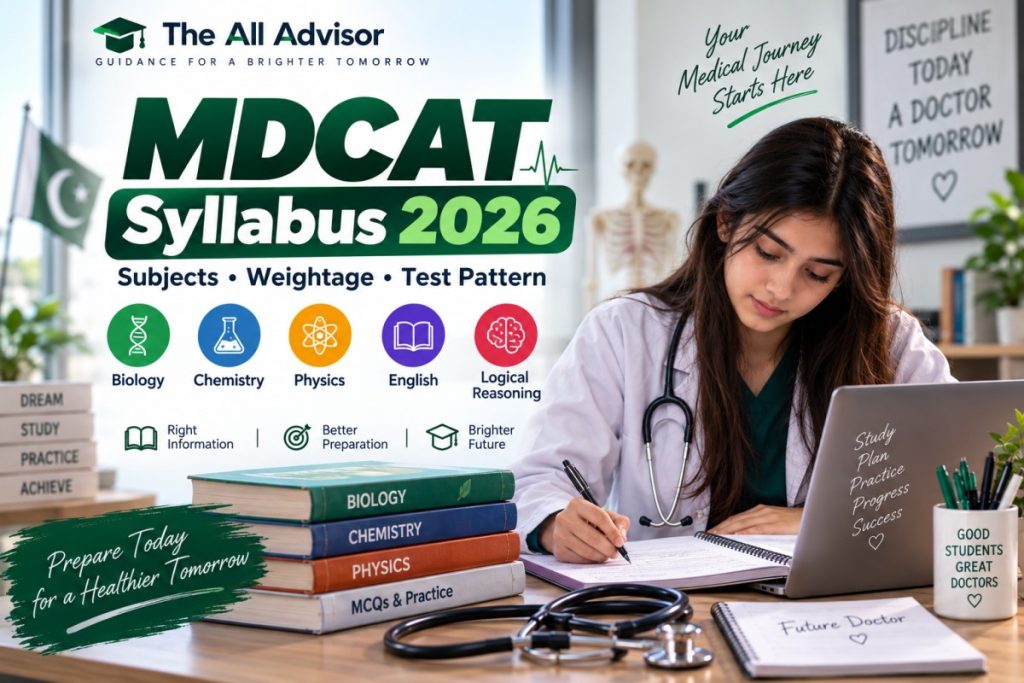
The MDCAT 2026 examination is structured as a multiple-choice, paper-based test conducted in English.
The test consists of 180 MCQs.
One useful feature for candidates is that the current test pattern specifies no negative marking.
The subject distribution is:
Biology – 81 MCQs
Biology carries the largest share of questions in MDCAT.
This makes Biology particularly important for candidates preparing for the examination. However, students should avoid interpreting the higher weightage as a reason to neglect other subjects. A competitive overall performance requires balanced preparation.
Chemistry – 45 MCQs
Chemistry contributes 45 questions.
Students should develop both conceptual understanding and the ability to apply concepts to MCQ-based problems rather than depending exclusively on memorization.
Physics – 36 MCQs
Physics contributes 36 questions.
For many candidates, Physics becomes a time-management challenge because some questions may require conceptual reasoning or calculations. Regular practice can therefore be as important as reviewing theory.
English – 9 MCQs
English contributes 9 questions.
Although its numerical share is smaller than the three core science subjects, these marks still contribute to the candidate’s total score.
Logical Reasoning – 9 MCQs
Logical Reasoning also contributes 9 questions.
This component evaluates reasoning rather than simply recalling scientific information. Candidates should become familiar with the type of logical thinking expected in the official syllabus.
MDCAT 2026 Subject Weightage
The distribution of 180 questions means that the approximate subject weightage is:
| Subject | MCQs | Approx. Share |
|---|---|---|
| Biology | 81 | 45% |
| Chemistry | 45 | 25% |
| Physics | 36 | 20% |
| English | 9 | 5% |
| Logical Reasoning | 9 | 5% |
| Total | 180 | 100% |
This distribution provides students with a useful framework for allocating preparation time.
It does not mean that a student should study only according to percentages. A better approach is to identify both high-weightage subjects and personal weak areas.
For example, a student who is already strong in Biology but consistently loses marks in Physics may benefit more from additional Physics practice than from simply allocating 45% of all study time to Biology.
Difficulty Level of MDCAT 2026
The announced MDCAT 2026 pattern also provides a broad distribution by difficulty level:
- 15% Easy
- 70% Moderate
- 15% Difficult
This is useful because it shows why preparation should focus on understanding concepts rather than expecting an examination made entirely of either straightforward or exceptionally difficult questions.
With the majority of questions falling within the moderate category, candidates should aim to develop reliable conceptual understanding across the complete syllabus.
Is There Negative Marking in MDCAT 2026?
According to the announced MDCAT 2026 pattern, there is no negative marking.
This means an incorrect answer does not carry an additional mark deduction under the stated pattern.
However, candidates should still answer carefully. The absence of negative marking should not become an excuse for poor time management or careless reading of questions.
MDCAT 2026 Syllabus
PM&DC announced that the MDCAT curriculum/syllabus 2025 is applicable to MDCAT 2026.
The test covers:
- Biology
- Chemistry
- Physics
- English
- Logical Reasoning
Students should use the syllabus published through PM&DC as the boundary for their preparation.
A common mistake is allowing academy notes, social-media discussions, or very large reference books to determine what should be studied. Supplementary material can certainly help with understanding, but the official syllabus should remain the primary roadmap.
Before starting serious preparation, candidates can turn the official syllabus into a checklist and classify topics into three groups:
Strong: topics that need only revision.
Average: topics understood but requiring additional MCQ practice.
Weak: topics that require conceptual study before practice.
This creates a more efficient study strategy than reading every chapter repeatedly from beginning to end.
Students should review the official MDCAT syllabus published by the Pakistan Medical and Dental Council (PM&DC) to understand the prescribed subjects, topics, and learning objectives before starting their preparation.
For a detailed subject-by-subject breakdown, explore our MDCAT syllabus 2026 guide covering Biology, Chemistry, Physics, English, Logical Reasoning, subject weightage, and the complete test pattern.
How MDCAT Registration Works
MDCAT registration is conducted online according to the process announced for the relevant examination cycle.
For MDCAT 2026, PM&DC directed candidates to use its designated MDCAT registration portal.
Candidates should complete the application carefully and make sure all required information is entered correctly.
A sensible registration process is:
- Read the current PM&DC notice before starting.
- Access the designated MDCAT registration system.
- Create or access the required candidate account.
- Enter personal and academic information accurately.
- Select the appropriate examination centre according to the applicable rules.
- Complete the prescribed payment process.
- Review the application before final submission.
- Keep a copy or record of relevant application and payment information.
- Continue checking the portal and PM&DC announcements for subsequent instructions.
Candidates should never wait until the last few minutes of a registration deadline if they can reasonably apply earlier. Technical issues, payment problems, incorrect information, or document-related questions become much harder to resolve under deadline pressure.
Choosing an MDCAT Test Centre
PM&DC’s 2026 registration notice listed examination locations across Pakistan’s provinces and regions, as well as an international centre.
The listed cities included multiple centres across Punjab, Sindh, Khyber Pakhtunkhwa and Balochistan, along with locations serving Islamabad, AJK and Gilgit-Baltistan.
The notice also included specific rules connecting candidates’ test-centre selection with their province or region of domicile.
Candidates should therefore not assume they are free to select any city simply because it is more convenient.
Always read the centre-selection instructions applicable to your domicile before submitting the application.
This is especially important because the notice states that a city/centre, once selected, cannot be changed.
Documents and Information Students Should Keep Ready
The exact registration requirements should always be checked against the current application portal and official notice.
As a practical matter, students should organize their identity, academic and application-related records before beginning registration.
Depending on the requirements applicable to the candidate, this may involve information or documentation relating to:
- Personal identification
- Academic qualifications
- Domicile
- Recent photograph
- Contact information
- Payment
- Application confirmation
The safest approach is not to rely on an old checklist from a previous MDCAT cycle. Requirements can change.
Why MDCAT Matters for MBBS and BDS Admission
MDCAT is important because passing the examination forms part of the mandatory admission eligibility framework for students seeking admission through the standard route to undergraduate medical and dental colleges in Pakistan.
But there is a crucial distinction:
Passing MDCAT ≠ Securing an MBBS/BDS Seat
Passing establishes one important part of eligibility.
Admission itself remains subject to merit and other applicable requirements.
For public medical and dental colleges, PM&DC’s current FAQ states the following merit weightage:
- MDCAT: 50%
- FSc/HSSC or equivalent: 40%
- SSC/Matric or equivalent: 10%
This illustrates why students should take their school and college academic performance seriously alongside MDCAT.
A strong MDCAT score can make a major contribution to aggregate merit, but it does not exist independently of previous academic performance.
MDCAT Aggregate – Basic Concept
Students often hear terms such as aggregate, merit percentage, and closing merit without clearly understanding the difference.
An aggregate combines the components specified in the relevant admission formula.
Using the public-college weightage currently described by PM&DC, the broad structure is:
MDCAT contribution + HSSC contribution + SSC contribution = aggregate
However, students should check the final admission policy applicable to the institution, province, category, and admission session for which they are applying.
Do not confuse an aggregate calculated for planning purposes with an official merit position.
Passing MDCAT and Getting Admission Are Different Goals
This distinction deserves special attention.
A candidate can:
Pass MDCAT but still not secure admission in the desired college.
Why?
Because medical admissions are competitive.
Suppose a large number of applicants satisfy the basic eligibility requirements but the number of available seats is much smaller. Colleges or admitting authorities then use the applicable merit system to determine which candidates receive offers.
Students should therefore prepare with two separate objectives:
Objective 1: Satisfy the required MDCAT and admission eligibility conditions.
Objective 2: Build the strongest possible aggregate to compete for the desired medical or dental seat.
The second goal generally requires performance beyond merely reaching a minimum threshold.
MDCAT for MBBS vs BDS
MDCAT is relevant to both undergraduate medical and dental admissions.
Students interested in:
MBBS – Bachelor of Medicine, Bachelor of Surgery
or
BDS – Bachelor of Dental Surgery
should understand the admission framework applicable to their chosen program.
The competition, available seats and closing merit may differ between MBBS and BDS and between institutions. Candidates should therefore research both options based on their genuine career interests rather than treating BDS only as an automatic backup.
Public vs Private Medical Colleges
Pakistan has both public and private medical and dental colleges recognized within the applicable regulatory framework.
The admission experience can differ significantly between the two sectors, particularly in areas such as:
- Fee structure
- Number and type of available seats
- Admission administration
- Competition and merit
- Financial planning
Regardless of sector, students should verify that the institution they are considering is properly recognized.
PM&DC maintains information on recognized undergraduate institutions, including public and private medical and dental colleges.
Never choose a medical institution simply because an advertisement claims that it offers an MBBS or BDS program. Recognition is a fundamental consideration for a medical career.
How to Prepare for MDCAT 2026
Good MDCAT preparation requires more than completing a large number of MCQs.
A practical preparation system can be divided into four stages.
Stage 1: Understand the Official Syllabus
Start with the syllabus rather than a random preparation book.
List every topic and mark your current level of understanding.
This immediately shows where your preparation stands.
Stage 2: Strengthen Concepts
Work on conceptual understanding before trying to maximize speed.
This is particularly important in Physics and Chemistry, where memorizing answers without understanding the underlying concept can become ineffective when a question is presented differently.
Stage 3: Practice MCQs
Once a topic is understood, practise relevant MCQs.
When an answer is wrong, do not simply memorize the correct option. Ask:
Why was my answer wrong?
The reason may be:
- A missing concept
- A forgotten fact
- A calculation error
- Misreading the question
- Confusion between two similar concepts
- Poor time management
Identifying the reason turns mistakes into useful feedback.
Stage 4: Timed Revision
Closer to the examination, students should become comfortable working under time limits.
The objective is not simply to answer questions quickly. It is to maintain accuracy while making efficient decisions under examination pressure.
A Smarter Daily Preparation Strategy
Instead of studying one subject for an entire day, many students may benefit from dividing their schedule.
For example:
Morning: difficult conceptual topic
Afternoon: second science subject
Evening: MCQ practice
Short session: English or Logical Reasoning
End of day: review mistakes
The exact timetable should depend on the student’s strengths, available time, college schedule, and stage of preparation.
There is no universal MDCAT timetable that works equally well for every student.
Common MDCAT Preparation Mistakes
Studying Without the Official Syllabus
Students sometimes collect so much preparation material that they lose track of what the examination actually covers.
Use the syllabus as your roadmap.
Ignoring Weak Subjects
Spending all available time on a favourite subject can feel productive while leaving a major scoring weakness unresolved.
Memorizing MCQ Answers
Learning the answer to a specific question is not the same as learning the concept.
Collecting Too Many Books
Five incomplete resources are usually less useful than one well-organized study system.
Ignoring English and Logical Reasoning
Their combined share is smaller than Biology, Chemistry, and Physics, but those marks still count.
Focusing Only on Passing
For competitive medical admission, candidates should generally aim for the strongest score they can achieve rather than building a strategy around the minimum possible performance.
Depending on Unverified Social-Media Information
Dates and policies can change.
Always verify major decisions against the latest official information.
Do You Need an Academy for MDCAT?
Joining an academy is not automatically necessary for every candidate.
An academy may provide:
- Structured classes
- Regular testing
- Teacher support
- Study schedules
- Competitive practice
But students can also prepare independently if they have strong concepts, appropriate resources, discipline and an effective testing routine.
The more important question is not:
“Which academy guarantees MDCAT success?”
It is:
“Which study system helps me identify and improve my weaknesses consistently?”
No academy can replace the student’s own preparation.
Can You Prepare for MDCAT at Home?
Yes, self-study can be a viable preparation approach.
A home-preparation system should ideally include:
- The official syllabus
- Reliable academic resources
- Topic-by-topic revision
- Regular MCQ practice
- Timed testing
- A record of mistakes
- Periodic performance review
Students studying at home should pay particular attention to accountability. Without scheduled classes, it becomes easier to postpone difficult topics.
A weekly target system can help solve this problem.
MDCAT and NUMS MDCAT Are Not the Same Thing
Students frequently use the terms MDCAT and NUMS MDCAT interchangeably, but they should not automatically assume that the two admission routes are identical.
NUMS has its own admission-test arrangements for institutions and programs falling within its applicable admission framework.
A student considering medical colleges associated with NUMS should therefore separately check:
- NUMS eligibility
- NUMS admission test requirements
- Applicable institutions
- Registration schedule
- Merit rules
Understanding the distinction early can prevent students from missing an application or preparing under the wrong assumptions.
What Should Students Do After MDCAT?
Although MDCAT is an important milestone, students should think beyond the examination itself.
After completing the relevant admission test requirements, candidates should carefully follow the admission process for the colleges or admission systems they intend to apply to.
This may involve:
- Checking admission announcements
- Confirming eligibility
- Preparing academic documents
- Understanding merit calculations
- Selecting institutions
- Submitting applications
- Monitoring merit/admission updates
- Reviewing fee obligations
- Verifying college recognition before enrollment
Students should not assume that appearing in MDCAT automatically creates an application for every medical college.
The admission application process and the entrance examination are related, but they are not necessarily the same administrative step.
Students exploring medical and health sciences programs can also read our Riphah International University Admission guide to understand available programs, eligibility requirements, and the university application process.
How to Choose a Medical College After MDCAT
Choosing a medical college after MDCAT is an important decision that can influence your academic experience, clinical training, finances, and future career. Instead of selecting a college only because it is popular or well known, students should compare their options carefully.
Check PM&DC Recognition
The first step is to confirm that the medical or dental college is recognized by the Pakistan Medical and Dental Council (PM&DC). Recognition is an essential factor when considering an institution for MBBS or BDS education.
Evaluate the Teaching Hospital
Medical education involves both classroom learning and practical clinical training. Check the college’s affiliated or attached teaching hospital and consider the clinical exposure students may receive during their degree.
Compare the Complete Cost
For private medical colleges in particular, tuition can represent a significant financial commitment. Look beyond the first-year fee and consider the overall cost of the program, including tuition, accommodation, transportation, books, and other applicable expenses.
Consider Location and Living Arrangements
A college’s location can affect both your expenses and daily routine. Students moving to another city should consider hostel availability, living costs, transportation, distance from home, and the overall environment before making a decision.
Review the Academic and Clinical Environment
Look beyond buildings and promotional material. Consider the quality of teaching, faculty support, laboratories, learning resources, hospital exposure, student facilities, and the overall academic environment.
Think About Your Long-Term Goals
Every student has different priorities. One candidate may prefer a public medical college because of affordability, while another may prioritize location, clinical exposure, or a particular learning environment.
The right medical college is therefore not simply the most popular option. It is a recognized, financially manageable, and academically suitable institution that supports your medical education and long-term career goals.
Frequently Asked Questions About MDCAT 2026
What does MDCAT stand for?
MDCAT stands for Medical and Dental College Admission Test. It is an important component of the undergraduate medical and dental admission framework in Pakistan.
When is MDCAT 2026?
According to the latest PM&DC rescheduling announcement currently available, MDCAT 2026 is scheduled for 20 September 2026. Candidates should continue checking PM&DC for subsequent updates.
How many MCQs are in MDCAT 2026?
The announced MDCAT 2026 test pattern contains 180 multiple-choice questions (MCQs).
Which subjects are included in MDCAT 2026?
MDCAT 2026 includes Biology, Chemistry, Physics, English, and Logical Reasoning.
How many Biology questions are in MDCAT?
The announced MDCAT 2026 test pattern allocates 81 MCQs to Biology, making it the subject with the largest share of questions.
How many Chemistry questions are in MDCAT?
Chemistry accounts for 45 MCQs in the announced MDCAT 2026 test pattern.
How many Physics questions are in MDCAT?
Physics accounts for 36 MCQs in the announced MDCAT 2026 test pattern.
Is there negative marking in MDCAT 2026?
No. The announced MDCAT 2026 test pattern states that there is no negative marking.
Is MDCAT conducted in English?
Yes. The announced MDCAT 2026 test pattern describes the examination as being conducted in English.
Is MDCAT computer-based?
No. The announced MDCAT 2026 test pattern describes the examination as paper-based.
Does passing MDCAT guarantee MBBS admission?
No. Passing MDCAT satisfies an important eligibility requirement, but it does not automatically guarantee admission to an MBBS or BDS program. Admission also depends on merit, available seats, academic performance, and the applicable admission criteria.
What academic qualification is required for medical admission?
Under the current PM&DC admission regulations, candidates need an HSSC or equivalent recognized 12th-grade qualification and must satisfy the prescribed academic, subject, and other applicable admission requirements.
Are Biology and Chemistry compulsory for medical admission?
Under the current admission regulations, Biology and Chemistry are mandatory subjects, while the candidate may qualify with either Physics or Mathematics as the additional specified subject.
Can I prepare for MDCAT without an academy?
Yes. Students can prepare for MDCAT through self-study if they have reliable learning resources, a structured study plan, strong conceptual understanding, regular MCQ practice, timed testing, and sufficient discipline.
Should I only prepare Biology because it has the highest weightage?
No. Although Biology has the highest individual weightage, Chemistry, Physics, English, and Logical Reasoning collectively represent a substantial portion of the examination. A balanced preparation strategy is therefore important for achieving a competitive overall score.
Is MDCAT the same as NUMS MDCAT?
No. MDCAT and NUMS MDCAT should not automatically be treated as the same admission process. Students interested in institutions associated with NUMS should separately review the latest NUMS eligibility, admission test, registration, and merit requirements.
Final Thoughts
MDCAT is one of the most important stages for students planning to enter medical or dental education in Pakistan, but it becomes much easier to approach when the process is understood clearly.
Students should begin with three things: know the official requirements, understand the syllabus, and build a preparation strategy around their own strengths and weaknesses.
For MDCAT 2026, candidates are dealing with a 180-question, paper-based examination covering Biology, Chemistry, Physics, English and Logical Reasoning, with no negative marking under the currently announced pattern.
At the same time, students should remember that MDCAT is only one component of the broader medical admission journey. Academic qualifications, merit calculations, college applications, recognition, available seats and institutional requirements all matter.
Most importantly, avoid making important admission decisions from old screenshots or unverified posts. MDCAT schedules and administrative instructions can change, as the rescheduling of MDCAT 2026 itself demonstrates.
Use official information for decisions, prepare consistently, and treat MDCAT not simply as a test to pass but as one stage in building a competitive medical or dental admission profile.