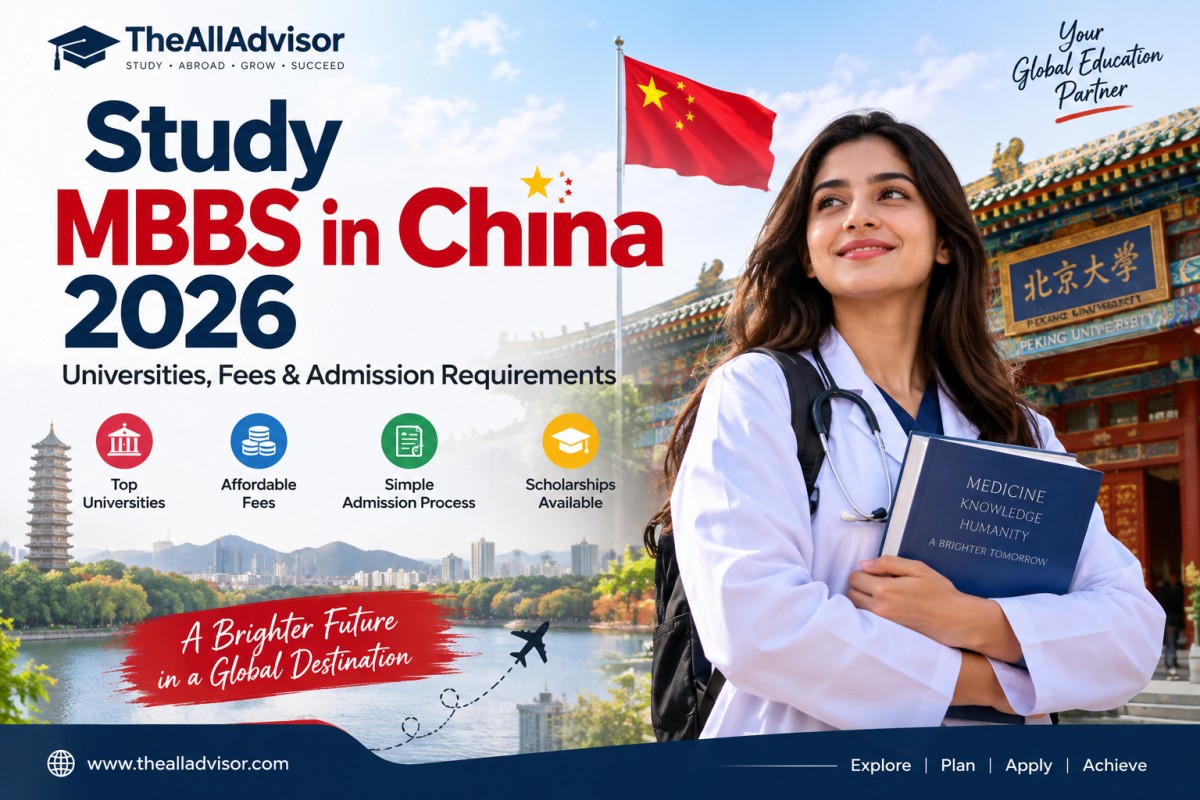
Study MBBS in China 2026: Universities, Fees & Admission Requirements
For international students considering a medical degree abroad, studying MBBS in China in 2026 can offer access to established medical universities, teaching hospitals, English-medium clinical medicine programs, and a different healthcare and cultural environment.
However, choosing an MBBS program in China requires much more research than simply finding a university with affordable tuition.
Students need to verify whether the university is currently permitted to enroll international students in its English-medium Clinical Medicine program, whether the degree will satisfy licensing requirements in the country where they eventually want to practise, what language requirements apply, how clinical training is structured, and what the complete six-year cost will be.
China’s Ministry of Education has established quality-control requirements for undergraduate medical education taught in English to international students. Under these standards, the program normally lasts six years, and the English version of the medical degree is stated as MBBS — Bachelor of Medicine and Bachelor of Surgery.
This guide explains the Study MBBS in China 2026 process for international students, including universities to research, admission requirements, tuition fees, program duration, required documents, scholarships, language requirements, application procedures, clinical internship, student visa considerations, and important recognition checks before enrollment.
MBBS in China 2026 at a Glance
| Category | Details |
|---|---|
| Program | Undergraduate Clinical Medicine / MBBS |
| Country | China |
| Typical duration | 6 years for English-medium MBBS |
| Degree | Bachelor of Medicine and Bachelor of Surgery (MBBS) |
| Medium | English for designated English-medium programs |
| Basic qualification | High school / secondary education |
| Important subjects | Biology, Chemistry and other sciences depending on university |
| English requirement | University-specific |
| Chinese language | Included/required during English-medium medical education |
| Internship | Normally included within the medical curriculum |
| Main intake | Usually autumn |
| Tuition | Varies by university |
| Scholarships | Government and university opportunities may be available |
| Student visa | Usually X1 for long-term degree study |
| Recognition | Must be verified for intended country of medical practice |
Students should use this table only as a starting point. Individual universities can set additional requirements for international medical applicants.
Why Study MBBS in China in 2026?
China has developed a large medical education and healthcare system supported by universities, medical schools, research institutions, and teaching hospitals.
For international applicants, one attraction is the availability of undergraduate Clinical Medicine programs offered in English at eligible institutions.
Students may consider China for several reasons:
- Six-year medical programs
- English-medium options at selected universities
- Clinical exposure through teaching hospitals
- Modern university infrastructure
- Medical research opportunities
- Scholarship options
- A large healthcare environment
- International student communities
- Different tuition levels across universities and cities
China can therefore be an option worth researching alongside other international medical destinations.
But affordability should never be the only reason for choosing a medical degree.
Your first questions should be:
Will this degree be acceptable to the medical regulator where I want to practise?
and
Is this particular university currently authorized to offer the relevant English-medium medical program to international students?
These questions should come before tuition comparisons.
Students who want to explore the broader study experience—including universities, admission requirements, tuition fees, living costs, scholarships, and student visas—can read our complete Study in China for International Students 2026 guide.
What Is MBBS Called in China?
International students will often see the terms MBBS and Clinical Medicine used when researching Chinese universities.
China’s Ministry of Education quality standards describe the relevant program as undergraduate medical education in Clinical Medicine taught in English for international students.
Under these standards, the program lasts six years. Students who successfully complete the university’s academic and graduation requirements receive a graduation certificate and medical degree, with the English version of the degree stating MBBS (Bachelor of Medicine and Bachelor of Surgery).
Therefore, when searching university websites, do not search only for “MBBS.”
Also look for:
- Clinical Medicine
- Clinical Medicine (MBBS)
- Clinical Medicine in English
- MBBS Program for International Students
- Undergraduate Clinical Medicine
How Long Is MBBS in China?
The standard English-medium undergraduate Clinical Medicine program for international students under China’s Ministry of Education standards is six years.
The curriculum combines academic medical education with clinical training.
China’s medical education standards specify that the internship component lasts one year, or at least 48 weeks.
This means students should plan financially and academically for the complete program rather than calculating only four or five years of tuition.
MBBS Curriculum in China
Although universities develop their own detailed curricula, medical education normally progresses from foundational sciences to clinical subjects and practical training.
Students may study subjects such as:
Basic and Pre-Clinical Sciences
- Anatomy
- Histology
- Embryology
- Physiology
- Biochemistry
- Molecular Biology
- Microbiology
- Pathology
- Pharmacology
- Immunology
- Medical Genetics
Clinical Subjects
Later stages can include:
- Internal Medicine
- Surgery
- Pediatrics
- Obstetrics and Gynecology
- Neurology
- Psychiatry
- Ophthalmology
- Dermatology
- Emergency Medicine
- Anesthesiology
- Diagnostic Imaging
- Rehabilitation Medicine
- Preventive Medicine
Students also receive practical clinical education and complete clerkship/internship requirements.
The exact curriculum should always be checked on the university’s official medical program page.
Is Chinese Language Required for English-Medium MBBS?
This is one of the most important points international applicants sometimes misunderstand.
An English-taught MBBS does not mean students can completely avoid learning Chinese.
China’s Ministry of Education standards require Chinese language to be a compulsory part of the English-medium undergraduate medical program for international students.
This makes practical sense.
Medical students eventually need to interact with:
- Patients
- Hospital staff
- Nurses
- Clinical supervisors
- Local communities
during clinical training.
Students should therefore be prepared to learn Chinese alongside their medical studies, particularly medical terminology and communication skills needed in clinical environments.
Best Medical Universities in China for International Students
China has many universities with medical schools, but applicants should be careful with online lists claiming that every institution offers an English-medium MBBS to international students.
The Ministry of Education has historically regulated which institutions can enroll international students in undergraduate Clinical Medicine programs taught in English.
Universities appearing on Ministry of Education lists have included institutions such as:
- Zhejiang University
- Fudan University
- Shanghai Jiao Tong University
- Wuhan University
- Huazhong University of Science and Technology
- Sichuan University
- Xi’an Jiaotong University
- Xiamen University
- Shandong University
- Jilin University
- China Medical University
- Dalian Medical University
- Nanjing Medical University
- Capital Medical University
- Tianjin Medical University
- Southern Medical University
- Chongqing Medical University
- Sun Yat-sen University
- Jiangsu University
- Wenzhou Medical University
This should not be interpreted as confirmation that every university above is accepting English-medium MBBS students in the 2026 intake.
Program availability changes.
Before applying, verify the 2026 international undergraduate admission notice and program catalogue directly on the university’s official website.
Students should verify current eligibility through the university and the Ministry of Education’s requirements for English-medium Clinical Medicine before applying.
Important: Do Not Choose a University Only by Ranking
University ranking can be useful, but medical students should consider several factors together.
Before choosing a Chinese medical university, investigate:
1. Current MBBS Availability
Does the university actually offer English-medium Clinical Medicine to international students for the 2026 intake?
2. Recognition
Will your intended licensing authority accept the degree and institution?
3. Teaching Hospital
Where will clinical training take place?
4. Language
How much Chinese will be required before clinical rotations?
5. Tuition
What is the complete six-year tuition cost?
6. Accommodation
Is university accommodation guaranteed?
7. Internship
Where can the final clinical internship be completed?
8. Licensing Pathway
What examinations or additional training will you need after graduation?
A lower tuition fee cannot compensate for a degree that does not meet your future professional requirements.
MBBS in China Admission Requirements 2026
There is no single admission standard used identically by every Chinese university.
Requirements depend on the institution.
However, applicants generally need to meet several basic conditions.
Academic Qualification
Applicants normally need to have completed high school or an equivalent secondary qualification that permits university admission.
For students from systems such as FSc, A Levels or equivalent qualifications, universities will evaluate whether the qualification meets their undergraduate entry requirements.
Science Subjects
Because medicine is a science-intensive program, universities can evaluate performance in subjects such as:
- Biology
- Chemistry
- Physics
- Mathematics
The exact subject combination and minimum grades vary.
Applicants should therefore check the 2026 MBBS admission requirements of the specific university rather than relying on a generic percentage found on an education blog or agent website.
English Language Requirements
English-medium MBBS applicants need sufficient English proficiency to study medical science effectively.
Universities may accept:
- IELTS
- TOEFL
- English-medium education certificate
- Other recognized evidence
- University-specific assessment
Policies vary.
For example, Xiamen University’s 2026 international undergraduate requirements specify IELTS Academic 6.0 or TOEFL iBT 80 for English-taught programs, while allowing certain applicants to use evidence that their high-school education was taught in English.
That does not mean these exact requirements apply to every Chinese medical university.
Can You Study MBBS in China Without IELTS?
Potentially, yes.
Some universities may accept alternative evidence of English ability.
For example, an institution may accept:
- Previous education taught in English
- TOEFL
- Another recognized English qualification
- An institution-specific alternative
But students should be careful with advertisements stating:
“MBBS in China without IELTS guaranteed.”
There is no universal rule that every English-medium MBBS program waives IELTS.
Always check the university’s current admission notice.
CSCA Requirement for MBBS Applicants in 2026
Applicants should also be aware of the China Scholastic Competency Assessment (CSCA) in current undergraduate admissions.
Requirements depend on the university.
For example, Xiamen University’s 2026 undergraduate admission rules require applicants to submit a CSCA score report. Mathematics is compulsory, while applicants to science, engineering, agriculture and medicine must select at least one of Physics or Chemistry according to the university’s published rules.
This is a good example of why applicants should not rely on admission guides from several years ago.
The 2026 application process may contain requirements that older MBBS articles do not mention.
Age Requirements
Age requirements vary between universities.
Some institutions establish their own age ranges for international undergraduate applicants.
For example, Xiamen University’s 2026 undergraduate admissions notice specifies that international undergraduate applicants should generally be 18–30 years old by September 1, 2026.
Other universities may use different limits.
Therefore, do not assume that “25 years” or “30 years” is a universal MBBS age limit across China.
Required Documents for MBBS in China
The exact checklist depends on the university, but international applicants commonly need documents such as:
- Valid passport
- Passport-size photograph
- High-school diploma or equivalent
- Academic transcripts
- Language proficiency evidence
- Birth certificate where required
- Recommendation letter where required
- Personal statement or study plan
- CSCA score where required
- Medical examination documents where required
- Non-criminal record where required
- Financial evidence where required
- Other university-specific documents
Applicants who have not yet completed high school may sometimes submit an official expected-graduation document and provide their final certificate later.
Documents issued in another language may need an official Chinese or English translation.
MBBS in China Application Process 2026
Although procedures differ by institution, most applicants can expect a process similar to the following.
Step 1: Decide Where You Want to Practise Medicine
This should happen before university selection.
Identify the country where you hope to practise after graduation and research its rules for foreign medical graduates.
Step 2: Create a Shortlist of Chinese Universities
Compare universities based on:
- 2026 MBBS availability
- Recognition
- Tuition
- Teaching language
- Clinical hospitals
- City
- Accommodation
- Scholarships
- Admission criteria
Step 3: Verify the University
Use the university’s official international admissions website.
Do not rely solely on:
- Agents
- Facebook groups
- WhatsApp messages
- Old university lists
- Unverified study-abroad websites
Step 4: Check 2026 Admission Requirements
Confirm:
- Academic qualification
- Required science subjects
- Age conditions
- English requirement
- CSCA requirement
- Application deadline
- Application fee
- Required documents
Step 5: Prepare Documents
Start early.
Passport renewal, translations, recommendation letters, academic verification and other documents can take time.
Step 6: Submit the Online Application
Most universities provide an online application portal for international students.
Complete all details exactly as they appear on your official documents.
Step 7: Pay the Application Fee
Some universities charge a non-refundable application fee.
For example, Xiamen University’s 2026 international undergraduate application fee is RMB 400.
Step 8: Complete Additional Assessment
Depending on the university, applicants may undergo:
- Document review
- CSCA
- Online interview
- Written assessment
- Academic evaluation
Step 9: Receive the Admission Decision
Universities evaluate applicants according to their academic and admission criteria.
An application does not guarantee admission.
Step 10: Complete the Student Visa Process
After receiving the required admission documentation, successful international students can proceed with the appropriate Chinese student visa process.
Long-term degree students normally require the relevant X1 visa route and subsequent residence formalities in China.
MBBS Fees in China for International Students 2026
There is no single MBBS tuition fee for China.
Fees vary according to:
- University
- City
- Program
- Accommodation
- Scholarship
- Additional university charges
Students should be particularly careful with websites that publish one figure and describe it as the “China MBBS fee.”
Each university establishes its own fee schedule.
Official 2026 MBBS Fee Example: Xiamen University
Xiamen University’s official 2026 international undergraduate admissions information lists its English-medium Clinical Medicine (MBBS) program as:
RMB 38,000 per academic year
with a program duration of:
6 years
The university also lists a RMB 400 application fee.
This means tuition alone, if the published annual rate remained unchanged throughout six years, would amount to approximately:
RMB 228,000
before accommodation, food, insurance, books, transportation, visa-related expenses and personal costs.
Students should treat this as an official example from one university, not a national average.
Fees can change and should always be reconfirmed before enrollment.
Other Costs of Studying MBBS in China
Tuition is only part of the budget.
International medical students should plan for:
Accommodation
Costs depend on university housing, room type and city.
Food
Campus cafeterias can help students manage costs, but spending varies by lifestyle.
Medical Insurance
International students are generally required to maintain appropriate medical insurance.
Books and Materials
Medical textbooks, lab materials and other academic resources can add to annual costs.
Residence and Visa Expenses
Immigration procedures may involve additional expenses.
Transportation
Budget for local travel as well as international flights.
Personal Expenses
Phone, internet, clothing, entertainment and travel should also be included.
Example of Living Costs at a Chinese University
Xiamen University’s current international-student cost information provides a useful example of how costs can vary.
The university lists food at approximately RMB 1,000–1,500 per month and insurance at RMB 800 per year.
Its accommodation costs differ by campus and room arrangement.
These figures should not be treated as averages for all of China.
Beijing, Shanghai, Guangzhou, smaller cities and individual university campuses can have very different costs.
How to Calculate Your Six-Year MBBS Budget
Before accepting admission, create a budget containing:
Annual tuition × 6 years
plus:
- Six years of accommodation
- Food
- Insurance
- Books
- Local transportation
- Flights
- Visa/residence expenses
- Medical examination costs
- Emergency fund
- Personal spending
Then consider possible fee increases.
This gives you a much more realistic picture than looking only at first-year tuition.
Scholarships for MBBS Students in China
International students may find different scholarship opportunities in China, including:
- Chinese Government Scholarship opportunities where applicable
- Provincial scholarships
- Municipal scholarships
- University scholarships
- Merit-based awards
However, students should not assume that every Chinese Government Scholarship covers every English-medium MBBS program.
Scholarship eligibility depends on the program, university, scholarship category and admission cycle.
Always check whether your exact Clinical Medicine / MBBS program is eligible.
Chinese Government Scholarship and MBBS
The Chinese Government Scholarship is one of China’s major international scholarship frameworks.
For a detailed overview of eligibility, funding benefits, monthly stipends, required documents, and Type A and Type B application routes, read our complete Chinese Government Scholarship 2026 guide.
Depending on the scholarship program, funding can include benefits such as:
- Tuition support
- Accommodation
- Living allowance
- Medical insurance
But applicants should verify whether undergraduate Clinical Medicine is available through their particular scholarship route.
Scholarship availability and MBBS admission availability are two separate questions.
Is MBBS in China Fully Funded?
Some medical students may obtain scholarships, but MBBS in China should not generally be advertised as automatically fully funded.
Many international students study on a self-funded basis.
Scholarships can be:
- Full
- Partial
- Tuition-based
- Merit-based
- University-specific
Read the exact scholarship terms before calculating your budget.
Clinical Training and Internship
Clinical education is central to an MBBS degree.
China’s Ministry of Education standards require institutions offering English-medium undergraduate medical education to have appropriate clinical teaching bases.
The standards specify that clinical teaching bases should be affiliated or teaching hospitals meeting required standards.
The curriculum includes clerkship and internship.
The internship is one year, with at least 48 weeks specified under the Ministry’s quality-control framework.
Students should ask the university:
- Which hospitals are used?
- When do clinical rotations begin?
- What Chinese-language ability is expected?
- Can internship be completed outside China?
- What approval is required for an overseas internship?
- Will the internship satisfy home-country licensing requirements?
Do not wait until the final year to investigate these issues.
Can You Complete Your Internship in Your Home Country?
China’s medical education standards allow institutions, under specified arrangements, to organize internships through host-university teaching hospitals or approved teaching hospitals abroad.
However, this does not mean every student can automatically return home for internship.
The university and relevant authorities must approve the arrangement.
Your home-country regulator may also have its own internship requirements.
Confirm both sides before making plans.
MBBS in China for Pakistani Students
China is one of the destinations Pakistani students consider for foreign medical education.
For Pakistani applicants, university admission is only one part of the decision.
Before paying tuition or signing an enrollment agreement, students should verify the current Pakistan Medical and Dental Council (PM&DC) rules for foreign medical graduates and whether the institution and qualification meet applicable requirements.
A university’s ability to enroll international students in China does not automatically guarantee that every graduate will qualify for registration in Pakistan.
Pakistani students should investigate:
- PM&DC requirements
- Recognition status
- Foreign medical graduate rules
- Required licensing examinations
- Internship/house-job requirements
- Program duration
- Clinical training
- Any student registration requirements applicable before going abroad
These checks should be completed before enrollment, not after graduation.
MBBS in China for Indian Students
Indian students should similarly verify current requirements imposed by India’s medical regulator before enrolling in a foreign medical program.
Important issues can include:
- Eligibility for foreign medical education
- Program duration
- Medium of instruction
- Internship requirements
- Licensing examination pathway
- Recognition and registration requirements
Foreign medical education rules can change, so students should use the regulator’s current official information rather than relying on old YouTube videos or admission-agent claims.
Is MBBS in China Recognized Worldwide?
This question needs careful wording.
There is no single “worldwide recognition” status that automatically gives a medical graduate the right to practise in every country.
Medical practice is regulated nationally.
A Chinese medical degree may be academically valid, but graduates who want to practise in another country can still need to satisfy that country’s:
- Medical regulator
- Licensing examination
- Internship requirements
- Credential verification
- Language requirements
- Postgraduate training rules
Therefore, instead of asking:
“Is this university recognized worldwide?”
ask:
“Does this degree meet the current licensing requirements in the country where I plan to practise?”
That is the more useful question.
How to Check Recognition Before Applying
Use this process:
- Identify your intended country of practice.
- Find its official medical regulator.
- Read its foreign medical graduate requirements.
- Check the university and degree requirements.
- Verify program duration and internship.
- Check licensing examination requirements.
- Contact the regulator directly if anything remains unclear.
- Keep official evidence of the rules you relied upon.
Never rely exclusively on a recruitment agent’s statement that a university is “WHO approved” or “globally recognized.”
MBBS in China Without NEET
Whether a student needs a home-country entrance or eligibility examination depends on the rules of the country in which they intend to obtain medical registration.
China’s university admission requirements and the student’s home-country licensing requirements are separate.
Therefore, a university accepting an applicant does not automatically mean the student has satisfied the medical regulator’s rules back home.
Indian applicants in particular should verify current requirements through the appropriate Indian medical authority before enrollment.
MBBS in China Without MDCAT
Similarly, Pakistani students should not assume that admission by a Chinese university automatically settles Pakistani regulatory requirements.
Requirements connected to foreign medical education and later registration in Pakistan should be checked directly through PM&DC.
If a current Pakistani regulation requires a particular examination, registration step or eligibility condition, students should complete it before leaving Pakistan where required.
MBBS in China Without an Entrance Exam
Some universities may use academic records and document assessment, while others can require:
- CSCA
- Interviews
- University assessments
- Subject-specific evaluation
Therefore, “MBBS in China without entrance exam” is not a reliable universal claim for the 2026 intake.
Current undergraduate admission processes are becoming more structured, and students should follow the exact requirements of their selected institution.
MBBS in China Intake 2026
The main undergraduate intake at many Chinese universities is the autumn intake, with classes generally beginning around September.
Application periods vary significantly.
For example, Xiamen University’s 2026 undergraduate applications opened on December 1, 2025. Its published deadlines differ depending on whether the applicant is applying for scholarships or as a self-funded student.
Other universities use their own schedules.
Start researching well before the intended intake.
When Should You Apply for MBBS in China?
A practical approach is to begin preparation several months before applications close.
Early Stage
Research:
- Universities
- Recognition
- Program availability
- Tuition
- Home-country licensing rules
Preparation Stage
Arrange:
- Passport
- Academic certificates
- Transcripts
- English-language evidence
- CSCA preparation where applicable
- Medical documents
- Required translations
Application Stage
Complete:
- University application
- Scholarship application if applicable
- Interview/assessment
- Fee payment
Do not wait until the final admission deadline to begin recognition checks.
China Student Visa for MBBS Students
Because MBBS is a long-term degree, successful international students generally need the appropriate long-term student visa process.
For China, the X1 visa is used for study exceeding 180 days.
After entering China, students must also follow the applicable residence-permit requirements.
Your university normally provides the necessary admission documentation and instructions.
Visa approval is separate from university admission.
Can MBBS Students Work Part-Time in China?
International students should not assume that a student visa provides unrestricted permission to work.
China has specific rules regarding international student work-study and internships.
Where off-campus activity is permitted, university approval and immigration/residence-permit procedures may apply.
Medical students should also consider whether employment is realistic alongside a demanding academic and clinical schedule.
Scholarship students may have additional scholarship conditions.
Advantages of Studying MBBS in China
Potential advantages include:
- English-medium medical programs at eligible institutions
- Six-year structured medical education
- Exposure to large teaching hospitals
- Modern university facilities
- Different tuition options
- Scholarship opportunities
- Experience living in China
- Opportunity to learn Mandarin
- Exposure to a large healthcare system
- Research opportunities at major universities
Challenges of Studying MBBS in China
Students should also consider the challenges.
Language Barrier
Even if classes are taught in English, clinical communication can require Chinese.
Recognition Requirements
Graduates may need licensing examinations and other requirements in their home countries.
Six-Year Commitment
Medicine requires substantial time and financial planning.
Cultural Adjustment
Living and studying in China may differ significantly from your home environment.
Clinical Communication
Communicating with patients can be difficult without adequate Mandarin.
Variable University Quality
Not every university provides the same educational experience.
Scholarship Limitations
Not every MBBS program is fully funded.
MBBS in China vs Studying Medicine at Home
Students should compare the complete pathway, not simply admission difficulty.
Consider:
| Factor | MBBS in China | Home-Country Medical Degree |
|---|---|---|
| Admission | University-specific | Local admission system |
| Language | English + Chinese may be needed | Usually familiar language |
| Clinical environment | Chinese healthcare system | Familiar healthcare system |
| Licensing after graduation | May require foreign graduate pathway | Usually more direct locally |
| Tuition | University-dependent | Institution-dependent |
| Living abroad | Yes | Usually no |
| Cultural adjustment | Significant | Lower |
| International experience | High | Varies |
Neither option is automatically better.
The correct choice depends on finances, academic profile, career plans and licensing pathway.
How to Choose the Right MBBS University in China
Before making a final choice, use a checklist.
Verify the 2026 Program
Make sure English-medium Clinical Medicine is actually accepting international students.
Check Recognition First
Confirm home-country regulatory requirements.
Review the Curriculum
Look at pre-clinical, clinical and internship components.
Investigate Teaching Hospitals
Strong clinical training matters as much as classroom education.
Compare Total Cost
Calculate six years, not one year.
Check Language Requirements
Understand both English admission requirements and Chinese-language expectations.
Review Graduate Outcomes
Where reliable data are available, investigate what international graduates do after completion.
Read Official Policies
University admissions pages and government/regulator websites should take priority over agent marketing material.
Red Flags to Avoid
Be cautious if an agent or website claims:
- “100% guaranteed admission”
- “No need to check recognition”
- “WHO approved means you can practise anywhere”
- “No Chinese language needed at all”
- “Guaranteed full scholarship”
- “No licensing exam after graduation”
- “All Chinese universities are recognized”
- “Pay immediately to reserve your seat”
Medical education is a major academic and financial commitment.
Verify important claims independently.
Frequently Asked Questions About MBBS in China 2026
Is China good for MBBS in 2026?
China can be a suitable option for international medical students because selected universities offer structured Clinical Medicine programs, teaching hospitals, and English-medium study. Whether it is a good option for an individual student depends on the university, budget, language ability, and future medical licensing plans.
How many years is MBBS in China?
Under China’s quality-control standards for English-medium undergraduate medical education for international students, the Clinical Medicine or MBBS program typically lasts six years, including academic study, clinical education, and internship requirements.
What are the requirements for MBBS in China?
Applicants generally need a recognized high-school qualification, appropriate academic performance, a strong science background, and sufficient language proficiency. Additional requirements such as CSCA scores, interviews, age limits, or specific subject results may depend on the university.
How much does MBBS cost in China?
MBBS tuition fees vary by university. As a current official example, Xiamen University’s English-medium MBBS tuition for 2026 is RMB 38,000 per year. Students should always check the latest official fee schedule of their chosen university rather than treating one figure as a national average.
Can I study MBBS in China in English?
Yes. Selected Chinese universities offer undergraduate Clinical Medicine programs taught in English for international students. Applicants should verify that their chosen university is currently offering the English-medium MBBS or Clinical Medicine program for the relevant intake.
Is Chinese language required for MBBS students?
Yes. Chinese language is part of the English-medium medical education framework for international students and becomes particularly important during clinical training, when students may need to communicate with patients, hospital staff, and clinical supervisors.
Can I study MBBS in China without IELTS?
Possibly. Some universities may accept alternatives to IELTS, such as previous English-medium education, TOEFL, another recognized English-language qualification, or a university-approved alternative. Requirements vary by institution.
Is MBBS in China fully funded?
Not automatically. Scholarships may be available for eligible students, but many international MBBS students are self-funded. Applicants should verify whether their specific Clinical Medicine or MBBS program is eligible for the scholarship they intend to apply for.
Can Pakistani students study MBBS in China?
Yes. Pakistani students can apply to eligible Chinese medical universities, but they should verify current Pakistan Medical and Dental Council (PM&DC) requirements for foreign medical education, university recognition, clinical training, and future professional registration before enrolling.
Is MBBS from China recognized in Pakistan?
Recognition and eligibility for medical registration in Pakistan depend on current PM&DC rules, the university, qualification, program structure, and other applicable requirements. Students should verify the latest information directly with PM&DC before enrolling in a Chinese medical university.
Can Indian students study MBBS in China?
Yes. Eligible Indian students can apply to Chinese medical universities, but they should verify all current foreign medical graduate, eligibility, internship, and licensing requirements imposed by India’s medical regulator before accepting admission.
Is an internship included in MBBS in China?
Yes. China’s English-medium undergraduate medical education standards include a clinical internship of one year, with at least 48 weeks specified in the quality-control framework.
Can I complete my MBBS internship outside China?
Certain arrangements may be possible under university and regulatory approval, but students should not assume that an overseas internship is automatically permitted. The requirements should be confirmed with both the Chinese university and the medical regulator in the country where the student intends to practise.
Which university is best for MBBS in China?
There is no single university that is best for every applicant. Students should compare current program availability, medical recognition, teaching hospitals, tuition fees, curriculum quality, language requirements, scholarships, location, and future licensing compatibility before choosing a university.
When should I apply for MBBS in China 2026?
Application dates vary by university. Many Chinese medical programs have an autumn intake, so students should begin researching universities, checking recognition, and preparing documents several months before the official application deadline.
Final Thoughts: Is MBBS in China Worth It in 2026?
Studying MBBS in China in 2026 can be worth considering for international students who find a suitable university, understand the language and clinical environment, can finance the full program, and have confirmed a realistic licensing pathway after graduation.
China offers English-medium Clinical Medicine programs at selected institutions, modern universities and access to large healthcare environments. But a medical degree is different from an ordinary international degree.
Your ability to practise medicine after graduation matters just as much as admission.
Before paying any application, admission or tuition fee, verify three things:
First: Is the university offering the relevant MBBS/Clinical Medicine program to international students for the 2026 intake?
Second: Does the program meet the current requirements of the medical regulator in the country where you intend to practise?
Third: Can you realistically afford the complete six-year cost, including tuition, accommodation, food, insurance, travel and other expenses?
Once these points are clear, compare curriculum quality, teaching hospitals, scholarships, city, language requirements and student support.
Students who want a broader understanding of Chinese higher education can also explore our complete Study in China for International Students 2026 guide, covering universities, scholarships, tuition fees, living costs, admissions and student visas.
For students seeking financial support, our detailed Chinese Government Scholarship 2026 guide explains CSC eligibility, benefits, required documents, Type A and Type B routes and the application process.
Before making your final decision, explore our Study in China for International Students 2026 guide for a broader overview of Chinese universities, admissions, tuition fees, living costs, and student visas. Students looking for funding opportunities can also read our Chinese Government Scholarship 2026 guide for detailed information about CSC eligibility, benefits, and the application process.