
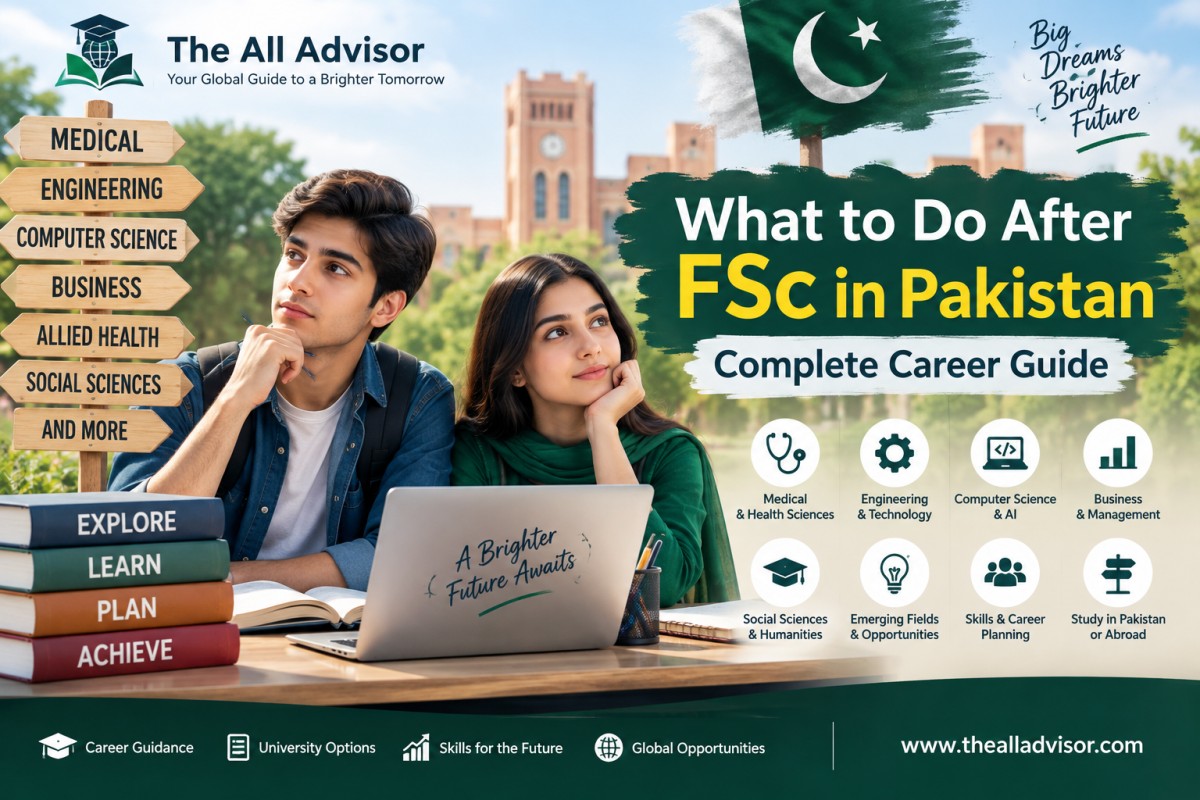
What to Do After FSc in Pakistan – Complete Career Guide
Completing FSc can feel like reaching the end of a long academic journey, but in reality, it is the point where one of the most important decisions begins.
For years, the path is relatively clear: school, Matric, then intermediate. After FSc, however, there is no single road that every student has to follow.
A Pre-Medical student may be thinking about MBBS but wondering what happens if the merit does not work out. A Pre-Engineering student may be deciding between engineering and computer science. Another student may have good marks but still have no idea which field actually suits them.
That uncertainty is normal.
The right question is not simply:
“Which degree should I choose after FSc?”
A better question is:
“Which academic and career path matches my abilities, interests, circumstances and the kind of future I want to build?”
At The All Advisor, our goal is to help students make education and career decisions using clear information rather than pressure, trends or assumptions. This guide explores the major options after FSc in Pakistan and provides a practical framework for deciding what to do next.
What Can You Do After FSc in Pakistan?
After FSc, students can generally move towards one of several broad pathways:
- university education,
- medical and health sciences,
- engineering and technology,
- computing and artificial intelligence,
- natural and applied sciences,
- business and management,
- social sciences,
- professional qualifications,
- skills-based education,
- entrepreneurship, or
- a planned gap period before higher education.
Your FSc subject combination influences which programs you can enter directly, but it does not necessarily determine your entire career.
The important point is to check the actual eligibility requirements of the university and program you want to join.
First Decide: Degree, Career or Both?
One of the biggest mistakes students make after FSc is treating a degree and a career as if they were the same thing.
They are connected, but they are not identical.
A degree tells you what you will study.
A career describes the kind of work, profession or professional direction you may eventually pursue.
For example:
BS Computer Science is a degree.
Software development, artificial intelligence, cybersecurity, data science and technology entrepreneurship are possible career directions that may follow from a computing background.
Similarly:
MBBS is an academic and professional pathway, but medicine itself contains numerous specialties and career directions.
Therefore, before selecting a degree, think beyond the next four years.
Ask:
What could this degree allow me to learn, build and become?
What to Do After FSc Pre-Medical in Pakistan
FSc Pre-Medical students often experience the most pressure because many begin intermediate education with one target:
MBBS.
MBBS can be an excellent choice for students who genuinely want to become doctors, understand the demands of medical education and are prepared for the competitive admission process.
But not securing an MBBS seat does not mean your academic future has ended.
Pre-Medical students have considerably more options than many realize.
1. MBBS
MBBS remains the primary route for students who want to practise medicine as physicians.
Before choosing this path, consider more than prestige.
Think about:
- your interest in medicine,
- academic ability,
- admission requirements,
- length of education and training,
- cost,
- clinical environment,
- professional licensing requirements, and
- your willingness to continue learning for many years.
Medicine should be chosen because the work suits you—not simply because people around you expect it.
Students planning to pursue MBBS or BDS should verify current admission and recognition requirements through the Pakistan Medical and Dental Council (PM&DC).
2. BDS
Bachelor of Dental Surgery can be considered by students interested in oral health and dentistry.
It has its own academic, clinical and professional requirements and should be evaluated as a separate profession rather than merely a backup for MBBS.
3. Doctor of Pharmacy
Pharmacy can lead towards areas including:
- hospital pharmacy,
- community pharmacy,
- pharmaceutical industry,
- quality assurance,
- regulatory affairs,
- research, and
- related healthcare roles.
Students considering Pharm-D should investigate the curriculum and realistic career environment before enrolling.
4. Allied Health Sciences
Healthcare is much larger than medicine and dentistry.
Depending on the institution and eligibility requirements, students may encounter programs related to areas such as:
- Medical Laboratory Technology
- Medical Imaging Technology
- Respiratory Therapy
- Optometry
- Operation Theatre Technology
- Nutrition
- Speech and Language Pathology
- Emergency and intensive-care related disciplines
- other allied health specialties
Program names and professional recognition can vary, so verify the specific degree carefully.
5. Biotechnology
Biotechnology combines biological sciences with technological and laboratory applications.
Students interested in biology, genetics, laboratory work and research may find this field worth exploring.
Possible directions can include:
- research,
- biotechnology companies,
- laboratories,
- agriculture-related biotechnology,
- pharmaceuticals,
- bio-industry, and
- postgraduate education.
6. Bioinformatics
Bioinformatics sits at the intersection of biology, computing and data.
It may appeal to students who enjoy biological sciences but are also interested in technology and analytical work.
Students should review the actual university curriculum because programs with similar names can differ considerably in emphasis.
7. Psychology
Students interested in human behaviour, mental processes, research and people-focused work may consider psychology where they meet admission requirements.
It is important to understand that becoming qualified for particular professional psychology roles may require education beyond an undergraduate degree.
8. Public Health
Public health looks at health from a population and systems perspective rather than focusing only on individual clinical treatment.
It can involve:
- health education,
- epidemiology,
- community health,
- policy,
- research,
- health programs, and
- disease prevention.
Can Pre-Medical Students Move to Computer Science?
This question has become increasingly important.
Yes, Pre-Medical students can be eligible for computing programs under the applicable computing admission framework.
NCEAC’s accreditation manual states that students with Intermediate Pre-Medical or equivalent 12-year education can apply to BS/BSc computing programs; where admitted, they are required to complete two additional Mathematics courses totaling six credit hours during the first year.
However, this should not be interpreted as automatic admission to every computing degree at every university.
Universities can have their own admission procedures, merit requirements and program availability.
Therefore, a Pre-Medical student considering:
- Computer Science,
- Artificial Intelligence,
- Data Science,
- Cyber Security,
- Software Engineering, or
- other computing programs
should verify the latest eligibility criteria of the specific university before applying.
Most importantly, do not switch to computing simply because “AI is trending.”
Try mathematics, basic programming and problem-solving first. See whether you actually enjoy the type of thinking involved.
Best Fields After FSc Pre-Engineering in Pakistan
Pre-Engineering students also face a much wider choice than traditional engineering alone.
Potential pathways include:
- Engineering
- Computer Science
- Software Engineering
- Artificial Intelligence
- Data Science
- Cyber Security
- Mathematics
- Physics
- Architecture
- technology-related programs
- business and interdisciplinary programs where eligible
Let’s look at the major directions.
1. Engineering
Engineering remains suitable for students who enjoy mathematics, physics, systems, design and practical problem-solving.
Depending on university availability and eligibility, disciplines can include:
- Electrical Engineering
- Mechanical Engineering
- Civil Engineering
- Chemical Engineering
- Computer Engineering
- Mechatronics
- Environmental Engineering
- Industrial Engineering
- other specialized engineering disciplines
Do not choose “engineering” as one generic field.
Research the individual branch.
A student who enjoys electronics and circuits may have very different interests from someone who wants to design structures or mechanical systems.
Students considering an engineering degree should also check the program’s accreditation status with the Pakistan Engineering Council (PEC).
2. Computer Science
Computer Science is one of the broadest technology pathways.
Modern computing education increasingly covers areas beyond traditional programming. HEC’s revised Computer Science Curriculum 2025 incorporates emerging areas including Artificial Intelligence, Data Science, Cybersecurity, Cloud Computing and the Internet of Things, while emphasizing project-based and industry-oriented learning.
A CS graduate may eventually move towards areas such as:
- software development,
- artificial intelligence,
- data,
- cybersecurity,
- cloud technologies,
- research,
- product development, or
- entrepreneurship.
But a degree alone is not enough.
Practical ability matters.
3. Software Engineering
Software Engineering focuses strongly on building and managing software systems.
It can suit students who enjoy:
- programming,
- logical thinking,
- designing applications,
- solving technical problems,
- software architecture,
- teamwork, and
- building digital products.
Computer Science and Software Engineering overlap considerably, so compare curricula instead of deciding purely on degree titles.
4. Artificial Intelligence
Artificial Intelligence has become one of the most discussed academic fields.
AI-related study can involve:
- machine learning,
- programming,
- mathematics,
- data,
- intelligent systems,
- computer vision,
- natural language processing, and
- related computational areas.
Students should understand one thing:
Using AI tools and studying AI are very different activities.
An AI degree can require substantial mathematical and programming work.
Choose it because you are interested in the underlying discipline, not merely because AI applications are popular.
5. Data Science
Data Science may suit students who enjoy a combination of:
- mathematics,
- statistics,
- programming,
- analysis, and
- solving problems using data.
Before selecting a dedicated Data Science degree, compare its curriculum with Computer Science and other computing programs.
Sometimes a broader undergraduate foundation followed by specialization can also make sense.
6. Cyber Security
Cybersecurity focuses on protecting digital systems, networks, applications and information.
Students interested in computing systems, networks, security and analytical problem-solving may explore this direction.
Again, check program accreditation and curriculum rather than relying on the attractiveness of the degree name.
Emerging Fields Students Are Considering
Students entering university now will graduate into a labour market that may look different from today’s.
Some areas receiving increasing academic and industry attention include:
Artificial Intelligence
AI is becoming integrated into software, healthcare, finance, manufacturing, education and numerous other sectors.
Data and Analytics
Organizations increasingly use data to understand customers, operations, risk and performance.
Cybersecurity
More digital activity creates a greater need to protect systems and information.
Cloud Computing
Modern applications and digital services increasingly rely on cloud infrastructure.
Robotics and Automation
Engineering, computing and AI increasingly intersect through automation and intelligent systems.
Biotechnology
Advances in biological sciences continue to create interdisciplinary opportunities.
Renewable Energy
Energy transition and sustainability are creating new technical and research challenges.
However, “emerging” does not mean “guaranteed employment.”
A field can grow while individual graduates still struggle if they lack practical skills.
What If You Are Still Confused After FSc?
Do not choose a degree just to end the confusion.
Use a simple decision framework.
Step 1: Identify Subjects You Actually Like
Write down the subjects and topics you genuinely enjoy.
Not the subjects people tell you are prestigious.
Ask yourself:
- Do I enjoy biology?
- Do I enjoy mathematics?
- Do I like working with computers?
- Do I enjoy writing and communication?
- Do I like solving numerical problems?
- Am I interested in business?
- Do I enjoy designing things?
- Do I like working directly with people?
Patterns will begin to appear.
Step 2: Identify What You Are Good At
Interest and ability are different.
You may enjoy something but need considerable improvement before studying it professionally.
That is not necessarily a reason to reject it.
It simply tells you what preparation will be required.
Look at:
- academic performance,
- problem-solving ability,
- communication,
- creativity,
- analytical thinking,
- practical skills, and
- consistency.
Step 3: Explore Careers Before Degrees
Suppose you are considering BS Artificial Intelligence.
Before choosing it, investigate what AI-related professionals actually do.
If you are considering medicine, understand a doctor’s working environment.
If you are considering civil engineering, learn what civil engineers work on.
YouTube videos, university curricula, professional organizations, job descriptions and conversations with people working in the field can help.
Do not base your decision on a degree advertisement.
Step 4: Compare 3–5 Fields
Create a simple table.
| Field | Interest | Academic Fit | Cost | Career Flexibility | University Options |
|---|---|---|---|---|---|
| Medicine | High/Medium/Low | High/Medium/Low | Check | Check | Check |
| Computer Science | High/Medium/Low | High/Medium/Low | Check | Check | Check |
| Engineering | High/Medium/Low | High/Medium/Low | Check | Check | Check |
| Biotechnology | High/Medium/Low | High/Medium/Low | Check | Check | Check |
| Business | High/Medium/Low | High/Medium/Low | Check | Check | Check |
Do not blindly calculate a score.
The purpose is to force yourself to compare choices objectively.
Choose the Program Before Choosing the University Brand
A famous university name can influence students strongly.
But you are not simply joining a university.
You are enrolling in a specific program at a specific campus.
Investigate:
- program curriculum,
- recognition,
- accreditation where applicable,
- faculty,
- laboratories,
- internships,
- projects,
- industry exposure,
- campus,
- total cost, and
- graduate pathways.
A strong fit between student and program can matter more than chasing a name without considering the degree itself.
Recognition and Accreditation Matter
Before paying an admission fee, students should verify their chosen institution and program.
HEC’s Undergraduate Education Policy establishes the overarching framework for undergraduate education across Pakistan’s higher education institutions, while discipline-specific accreditation councils can oversee programs falling within their respective areas.
For example, NCEAC’s scope includes bachelor-level computing programs such as BS Artificial Intelligence, BS Bioinformatics and BS Computer Science, among others.
Therefore, do not ask only:
“Is this university recognized?”
Also investigate:
“What is the status of my specific campus, degree program and relevant accreditation?”
Students should also verify their chosen university and campus through the HEC recognized campuses list before enrolling.
Do Skills Matter More Than Degrees?
This question creates an unnecessary either/or debate.
For many career paths, the strongest combination is:
Degree + Skills + Experience
A degree can provide:
- structured education,
- theoretical foundations,
- academic credentials,
- access to faculty,
- peer networks, and
- a pathway to postgraduate education.
Skills can provide:
- practical ability,
- portfolio evidence,
- workplace readiness,
- adaptability, and
- the ability to create real outcomes.
Experience teaches you how knowledge and skills work in real environments.
HEC announced in 2025 that undergraduate programs are to incorporate supervised internships and industry-relevant certifications as part of its employability-focused reforms, including a minimum three-credit-hour supervised internship requirement.
This reinforces an important lesson for students:
Do not wait until graduation to become employable.
Skills Students Can Start Building During University
Your skill set should depend on your chosen field, but some broadly useful capabilities include:
Communication
Learn to explain ideas clearly in writing and conversation.
English Proficiency
Strong English can help with academic material, international opportunities and professional communication.
Digital Literacy
Learn to work comfortably with modern productivity and collaboration tools.
Research
Know how to find reliable information, compare sources and distinguish evidence from opinion.
AI Literacy
Students should learn how AI tools work, where they help, where they fail and how to use them responsibly.
Problem Solving
Employers value people who can understand a problem and work towards a solution.
Presentation Skills
Being able to communicate your work can be nearly as important as completing it.
Field-Specific Skills
A CS student may need programming and projects.
An engineering student may need design, simulation or technical tools.
A business student may benefit from analytics, spreadsheets, communication and financial understanding.
A health-sciences student may need clinical, laboratory or research-related competencies.
Should You Take a Gap Year After FSc?
A gap year is neither automatically good nor automatically bad.
The real question is:
What will you do with it?
A planned gap year may make sense if you need to:
- prepare again for a competitive admission test,
- improve specific academic weaknesses,
- resolve financial issues,
- develop a portfolio,
- learn important skills,
- reconsider your career direction, or
- prepare for international applications.
An unplanned year spent waiting without a clear objective is different.
If you take a gap year, give it measurable goals.
For example:
Months 1–3: admission-test preparation
Months 4–6: skill development
Months 7–9: applications and portfolio
Months 10–12: admission preparation and backup planning
The exact plan will depend on your objective.
Should You Study in Pakistan or Abroad?
For some students, studying abroad may be worth considering.
But “abroad” is not automatically better.
Compare:
- university quality,
- program recognition,
- tuition,
- living expenses,
- scholarships,
- visa requirements,
- language,
- cultural adjustment,
- career plans, and
- recognition of the qualification in Pakistan if you intend to return.
For some students, a strong Pakistani university is the better choice.
For others, an international program may offer opportunities aligned with their goals.
Make the comparison based on the specific universities and programs, not countries alone.
If studying abroad is part of your future plan, start by researching destinations rather than choosing a country only because it is popular. Students interested in affordable European study options can explore our Study in Germany guide, while those considering universities and scholarship opportunities in Asia can continue with our Study in China guide.
What If Your FSc Marks Are Lower Than Expected?
A disappointing result can feel like every plan has collapsed.
It has not.
Marks influence which options are immediately available, but they do not define your entire professional life.
Start by separating three things:
Your result
Your ability
Your future potential
They overlap, but they are not identical.
If your marks limit entry to a highly competitive program, consider:
- alternative universities,
- related fields,
- different admission cycles,
- improving entry-test performance where relevant,
- programs with different merit structures,
- a structured gap year where appropriate, or
- another career route that fits your strengths.
Do not enroll in an unsuitable degree simply because it has a lower closing merit.
What If You Have Very High FSc Marks?
High marks give you more choices.
They do not make the choice easier automatically.
Do not assume that because you can enter medicine, you should become a doctor.
Do not assume that because you can enter engineering, engineering is right for you.
Academic performance opens doors.
You still have to decide which door is worth entering.
Parents and Students: Make the Decision Together
Parents often have more life experience and naturally want security for their children.
Students, meanwhile, will actually study and eventually work in the chosen field.
Both perspectives matter.
A useful conversation should include:
- student’s interests,
- academic ability,
- financial circumstances,
- university options,
- career prospects,
- location,
- family considerations, and
- backup plans.
The goal should not be for either side to “win.”
The goal is to make a decision that is informed and sustainable.
Common Mistakes After FSc
Following Friends
Your friend’s best degree may be your worst fit.
Choosing Only on Salary
Salary matters, but earning potential varies enormously within every profession.
Following Trends
Today’s most talked-about field may look very different four years from now.
Ignoring Mathematics
Students entering computing, engineering, economics, analytics and similar quantitative areas should understand the mathematical demands involved.
Ignoring Accreditation
A degree title can sound impressive while the actual program deserves closer investigation.
Ignoring Costs
Calculate the full cost of completing the degree, not only the first-semester fee.
Applying to One University
Always consider suitable backup options.
Thinking a Degree Guarantees a Job
It does not.
Use university to develop knowledge, practical skills, experience and professional relationships.
A Practical 30-Day Plan After FSc
If you have just received your result and do not know where to begin, use the next month productively.
Days 1–5: Self-Assessment
Identify:
- interests,
- strongest subjects,
- weak areas,
- preferred work environments,
- financial constraints, and
- long-term priorities.
Days 6–10: Career Research
Choose approximately five possible fields.
Research what professionals actually do in each one.
Days 11–15: Degree Research
Compare the university programs that lead towards those fields.
Read curricula rather than relying on advertisements.
Days 16–20: University Shortlist
Create three groups:
Ambitious choices
Realistic choices
Backup choices
Days 21–25: Verify Everything
Check:
- recognition,
- accreditation,
- eligibility,
- entry test,
- deadline,
- fee,
- campus, and
- required documents.
Days 26–30: Apply and Prepare
Submit suitable applications and begin preparing for tests, interviews or other admission requirements.
A Simple Career Decision Formula
There is no mathematical formula that can select your career perfectly.
But a strong decision usually sits somewhere at the intersection of:
Interest + Ability + Opportunity + Affordability + Long-Term Fit
If you consider only interest, you may overlook practical realities.
If you consider only money, you may choose work you dislike.
If you consider only your marks, you may underestimate yourself.
If you consider only market trends, you may chase a field that does not suit you.
The objective is balance.
Recommended Pathways After FSc
| Your Background/Interest | Areas Worth Exploring |
|---|---|
| Pre-Medical + Clinical Interest | MBBS, BDS and relevant health pathways |
| Pre-Medical + Biology/Research | Biotechnology, Bioinformatics, Biological Sciences |
| Pre-Medical + Technology Interest | Eligible computing programs, Bioinformatics, interdisciplinary fields |
| Pre-Engineering + Technology | CS, Software Engineering, AI, Data Science, Cyber Security |
| Pre-Engineering + Physics/Design | Engineering, Architecture and related disciplines |
| Strong Mathematics | Computing, Engineering, Mathematics, Statistics, Analytics |
| Business Interest | Business, Finance, Economics and related programs where eligible |
| Research Interest | Natural sciences, computing, engineering, social sciences and other research pathways |
| Unsure | Career exploration + university research before committing |
This table is a starting point, not an eligibility chart. Always verify the requirements of the specific program.
Frequently Asked Questions About What to Do After FSc
What should I do after FSc in Pakistan?
Start by identifying your interests, academic strengths and career goals. Then compare suitable degree programs, universities, eligibility requirements, costs and long-term career pathways before applying.
Which field is best after FSc?
There is no single best field for every FSc student. Medicine, computing, engineering, health sciences, biotechnology, business and other disciplines can all be suitable depending on the student’s background, interests and abilities.
What are the best options after FSc Pre-Medical?
Options may include MBBS, BDS, Pharm-D, allied health sciences, biotechnology, bioinformatics, public health, psychology, biological sciences and eligible computing programs, among others.
Can I do Computer Science after FSc Pre-Medical?
Under NCEAC’s computing admission framework, Pre-Medical students can be eligible for BS/BSc computing programs. Admitted students without the usual mathematics background may be required to complete two additional Mathematics courses totaling six credit hours during the first year. Individual university requirements should still be verified.
What are the best options after FSc Pre-Engineering?
Students may explore engineering, computer science, software engineering, artificial intelligence, data science, cyber security, mathematics, physics, architecture and other eligible programs.
Is AI a good field after FSc?
AI can be a strong option for students genuinely interested in mathematics, programming and computational problem-solving. Students should evaluate the curriculum and their aptitude rather than selecting AI only because it is currently popular.
Is Computer Science better than engineering?
Neither is universally better. Computer Science may suit students interested in software and computing, while different engineering disciplines focus on different physical and technical systems. The better choice depends on the individual.
What if I cannot get admission to MBBS?
Explore related health and biological sciences as well as completely different fields that match your interests and eligibility. Not securing an MBBS seat does not mean you must select a degree you do not want.
Can I change my field after FSc?
In many cases, yes, but eligibility varies by degree and university. Some transitions may require additional subjects or other conditions.
Should I take a gap year after FSc?
A gap year can make sense when it has a clear purpose, such as preparing for an admission test, improving skills or preparing applications. It should have specific goals rather than becoming an indefinite pause.
Should I choose a degree based on salary?
Salary should be one consideration, not the only one. Career earnings depend on field, skills, experience, location, specialization and individual performance.
Does a university degree guarantee a job?
No. Students should use university to build a combination of academic knowledge, practical skills, projects, internships, professional connections and experience.
How do I choose the right university after FSc?
Compare the specific program’s recognition, accreditation where relevant, curriculum, faculty, facilities, cost, location, internships and career pathways rather than choosing only by university name.
What if I still do not know which career to choose?
Reduce the decision to three to five possible fields, research each one deeply, speak with people who understand those professions and compare your interest, aptitude, affordability and long-term fit before committing.
Final Thoughts
Deciding what to do after FSc in Pakistan is not about finding one degree that everyone considers successful.
It is about finding a direction that makes sense for you.
For one student, that may be medicine.
For another, it may be computer science.
Someone else may find the right fit in engineering, biotechnology, psychology, business, health sciences or a field they had never seriously considered before completing intermediate education.
Do not allow one result, one merit list, one relative’s opinion or one social-media trend to make the entire decision for you.
Research the profession.
Compare degree programs.
Verify recognition and accreditation.
Understand the financial commitment.
Think about the skills you will need.
And keep backup options.
At The All Advisor, we believe good career decisions begin with informed choices. Our education and career guides are designed to help students compare pathways before committing years of study to them.
If you are currently searching for a university, continue with our University Admissions Open in Pakistan guide to explore admission opportunities, eligibility, entry tests and the application process.
Students who already know their intermediate stream can go deeper with our upcoming guides on Best Fields After FSc Pre-Medical in Pakistan and Best Fields After FSc Pre-Engineering in Pakistan.
Your FSc result tells you where you are today.
It does not decide how far you can go next.
